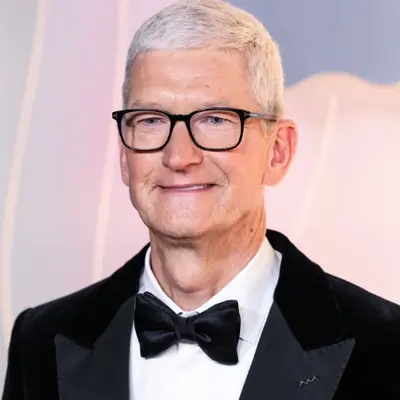
Tim Cook
Scorpio
65 years old
Who Is Tim Cook?
Timothy Donald Cook is an American business executive who has served as the chief executive officer (CEO) of Apple since 2011. He is one of the most admired and influential leaders in modern business history.
Under Cook’s leadership, Apple’s market capitalization exploded from roughly $350 billion to $4 trillion. Annual revenue nearly quadrupled from $108 billion in fiscal 2011 to more than $416 billion in fiscal 2025.
Furthermore, he made history in 2014 as the first openly gay CEO of a Fortune 500 company. He is not just a business leader. He is a cultural icon.
On April 20, 2026, Apple announced that Cook would step down as CEO on September 1, 2026, and transition to the role of executive chairman. Therefore, his legacy at Apple is now complete — and it is extraordinary.
Early Life: A Small-Town Alabama Boy With Big Dreams
Growing Up in Robertsdale, Alabama
Tim Cook was born Timothy Donald Cook on November 1, 1960, in the small town of Robertsdale, Alabama, United States. His father, Donald, was a shipyard worker, while his mother, Geraldine, worked at a pharmacy. He has two brothers.
His father worked as a foreman for the Alabama Dry Dock and Shipbuilding Company. His family resided briefly in Mobile and Pensacola, Florida, but settled in Robertsdale in part because they wanted their children to attend the same school.
Robertsdale is a small, quiet farming town near the Gulf Coast. It is far removed from Silicon Valley. However, it gave Tim Cook something no tech campus could — a deep sense of community, humility, and grit.
A Star Student With a Trombone and a Yearbook
When he was old enough to work, Tim held several part-time jobs, including delivering newspapers, working at a local restaurant, and working with his mother at the drugstore.
At Robertsdale High School, he was a member of the high school marching band, graduated second in his class, and was voted “most studious.” He also served on the school’s yearbook staff.
He graduated in 1978. His discipline was already evident. So was his ambition.
Education: Engineering Meets Business
Auburn University (1978–1982)
Cook attended Auburn University, having wanted to study there since he was a small child, and graduated in 1982 with a bachelor’s degree in industrial engineering.
His professors recalled him as a quiet and reserved student. However, his analytical mind was already taking shape. His engineering background gave him a powerful framework for solving complex, large-scale problems. That skill would later become his greatest professional weapon.
Duke University — Fuqua School of Business (MBA, 1988)
Working days and attending college at night, he earned a master’s of Business Administration degree from Duke University in 1988.
He was named a Fuqua Scholar — an honor bestowed only to business students who graduate in the top 10 percent of their class.
Therefore, Tim Cook entered the workforce as both an engineer and a business strategist. It was a rare and powerful combination.
Career Before Apple: Building a World-Class Foundation
IBM (1982–1994): Twelve Years of Supply Chain Mastery
Cook spent 12 years at IBM, managing its North American fulfillment operations. His final position was director of North American fulfillment.
This was not a glamorous role. But it was a crucial one. Cook learned to move products across continents. He learned to remove waste from complex systems. Most importantly, he learned that supply chains win markets.
Intelligent Electronics (1994–1997): The COO Role
Cook became Vice President and Chief Operating Officer of the Reseller Division at Intelligent Electronics. He sharpened his leadership skills here. He also built a reputation as someone who could streamline almost any operation.
Compaq (1997): A Brief but Pivotal Stop
He also worked as Vice President for Corporate Materials for Compaq, which at the time was the largest computer company in the world.
His time at Compaq was short. However, it prepared him for the most important call of his career — one that came from Steve Jobs himself.
Joining Apple: The Decision That Changed Everything
Steve Jobs Makes the Call (1998)
In 1998, Cook was recruited by Apple co-founder Steve Jobs to overhaul the company’s struggling manufacturing and distribution systems.
“My most significant discovery so far in my life was the result of one single decision: my decision to join Apple,” Cook stated at Auburn University’s commencement ceremony in 2010.
Many colleagues warned him not to go. Apple was in deep trouble. Nevertheless, Cook trusted his instincts. That instinct changed Apple’s history forever.
Rising Through the Ranks (1998–2011)
Cook joined Apple in March 1998 as senior vice president for worldwide operations, and then as vice president for worldwide sales and operations.
From 2002 to 2005, he served as executive vice president of Worldwide Sales and Operations. Cook served as chief operating officer from 2005 to 2011 and also as head of Apple’s Macintosh computer division.
During Steve Jobs’ medical leaves, Cook stepped in as acting CEO — not once, but twice. Each time, he proved he could steady the ship without losing the crew.
Becoming CEO: Succeeding a Legend
August 24, 2011: The Torch Is Passed
In August 2011, Cook was named Apple’s new CEO following the death of predecessor Steve Jobs.
The world was skeptical. Steve Jobs was irreplaceable — or so everyone thought. However, Tim Cook had no intention of becoming a copy. He had his own vision. He had his own values. He simply needed the stage.
Tim Cook’s rise from a small-town Southern boy to the CEO of the most valuable company in the world is a remarkable story of humility, precision, and quiet leadership.
Leadership at Apple: A Decade and a Half of Transformation
Apple Watch (2015): A New Product Category
Apple Watch (2015) became Apple’s first major new product category under Cook. It became the world’s best-selling smartwatch and a cornerstone of its health-tech ecosystem.
Cook had proved the doubters wrong. Apple did not need Jobs to innovate. It needed the right leader to channel the company’s creativity into new markets.
AirPods (2016): A Billion-Dollar Bet on Wireless
AirPods (2016) were wireless earbuds launched after Apple removed the headphone jack. They captured massive market share and created a new wearables revenue stream.
Critics mocked the decision to remove the headphone jack. However, Cook and his team saw the future clearly. AirPods became one of Apple’s most profitable product lines.
Apple Silicon — M1 Chip (2020): A Bold Engineering Leap
Apple Silicon / M1 Chip (2020) saw Apple replace Intel processors with its own in-house chips, dramatically improving Mac performance and battery life.
This was a massive undertaking. It was also a massive success. Apple’s computers became faster, cooler, and more efficient than anything the industry had seen.
Apple Vision Pro (2024): Entering Spatial Computing
Apple Vision Pro (2023/2024) marked a bold entry into spatial computing and augmented reality. It was ambitious. It was visionary. It reflected Cook’s belief in Apple’s power to define entirely new computing categories.
Apple Intelligence (2024): Embracing the AI Era
Apple Intelligence (2024) integrated OpenAI’s ChatGPT into Apple’s operating system, marking the company’s formal entry into the generative AI era.
Under Cook, Apple did not rush into AI. Instead, it moved deliberately and purposefully. The result was a deeply integrated AI experience across all Apple devices.
The Services Revolution
Beyond hardware, Cook engineered one of the most significant strategic pivots in corporate history. He built Apple’s services business — including the App Store, Apple Music, Apple TV+, Apple Pay, and iCloud — into a multi-billion-dollar revenue engine. The company’s active installed base grew to over 2.5 billion devices across more than 200 countries and territories.
The Numbers That Define His Legacy
Under Cook’s leadership, Apple’s stock price grew from approximately $13 (split-adjusted) in 2011 to approximately $273 in 2026 — roughly a 20-fold increase.
| Metric | 2011 (Cook’s Start) | 2026 (Cook’s End as CEO) |
|---|---|---|
| Market Capitalization | ~$350 billion | ~$4 trillion |
| Annual Revenue | $108 billion | $416+ billion |
| Stock Price | ~$13 (split-adjusted) | ~$273 |
| Active Devices | ~500 million | 2.5 billion+ |
| Countries Served | ~100 | 200+ |
Compensation and Net Worth
In 2025, Cook’s total compensation was $74.3 million. This included a $3 million base salary, with the remainder comprising stock awards, performance bonuses, and other benefits.
In 2024, driven by a massive stock rally and strong performance incentives, his total compensation reached $74.6 million.
As of 2026, his net worth exceeds $2.5 billion, mainly from stock-based compensation. He is not the richest tech billionaire. However, he is among the most respected.
Stepping Down as CEO: The End of an Era
April 20, 2026: A Historic Announcement
Apple announced that Tim Cook will become executive chairman of Apple’s board of directors and John Ternus, senior vice president of Hardware Engineering, will become Apple’s next chief executive officer effective on September 1, 2026.
Cook said in a statement, “It has been the greatest privilege of my life to be the CEO of Apple and to have been trusted to lead such an extraordinary company.”
Apple’s market cap increased by more than 20-fold on Cook’s watch, closing on the announcement day at $4 trillion.
John Ternus: The Next Chapter
Ternus will join the board of directors, also effective September 1, 2026. Arthur Levinson, who has been Apple’s non-executive chairman for the past 15 years, will become its lead independent director.
Cook did not simply hand over the keys. He spent months ensuring a smooth transition. That is precisely the kind of leader he has always been — steady, thoughtful, and always putting the mission first.
Coming Out: A Historic Moment of Courage
October 30, 2014: The World Listens
Cook came out as gay in an essay published by Bloomberg in 2014. He wrote: “If hearing that the CEO of Apple is gay can help someone struggling to come to terms with who he or she is, or bring comfort to anyone who feels alone, or inspire people to insist on their equality, then it’s worth the trade-off with my own privacy.”
He made history in 2014 as the first openly gay CEO of a Fortune 500 company.
Cook said he came out publicly because children wrote him letters saying they had been bullied or abused because of their sexual orientation. “I was public because I started to receive stories from kids who read online that I was gay,” he told CNN.
Cook views being gay as “God’s greatest gift to me.” “I’m very proud of it,” he said.
His decision resonated far beyond the business world. It was a moment of genuine moral courage — one that changed countless lives.
Values, Advocacy, and Philanthropy
Privacy as a Core Principle
Tim Cook believes privacy is a fundamental human right. Under his leadership, Apple became the tech industry’s loudest and most consistent voice for user privacy. He regularly speaks at data protection summits. He has openly challenged competitors on their data practices. Furthermore, Apple’s “Privacy. That’s iPhone.” campaign became one of the most recognized marketing messages in the world.
Environmental Commitment
Cook — who went out of his way to hire a former EPA head to develop Apple’s environmental program — made sustainability central to Apple’s mission. Apple became the first tech company of its scale to commit to being 100% carbon neutral across its entire supply chain by 2030.
Philanthropic Giving
In 2014, he donated to the Human Rights Campaign’s Project One America, which seeks to expand LGBTQ rights in the southern United States. He has also supported the Southern Poverty Law Center and various education and equality initiatives globally.
Boards, Honours, and Recognition
Beyond his role at Apple, Cook serves on the board of directors of Nike, Inc., sits on the board of the National Football Foundation, and is a trustee of Duke University.
His honours include:
- Time Magazine — 100 Most Influential People in the World (2012)
- Time Magazine — Person of the Year, Runner-Up (2012)
- Fortune Magazine — World’s 50 Greatest Leaders (2014)
- Auburn University — Lifetime Achievement Award (2014)
- Alabama Engineering Hall of Fame — Inducted 2009
- Auburn University — International Quality of Life Award (2013)
- Auburn University — Outstanding Industrial and Systems Engineering Alumnus of 2000
- Auburn University — Founding Chair of the Department of Industrial and Systems Engineering’s Alumni Council
Personal Life: The Private Man Behind the Public CEO
Cook is known for his solitude, choosing to work out in an off-campus fitness centre to avoid being recognized.
He describes himself as “an engineer, an uncle, a nature lover, a fitness nut, a son of the South, a sports fanatic, and many other things.”
Cook is often seen driving a BMW 5 Series, staying true to his reputation for practicality and understated luxury. He avoids the ostentatious supercars favored by many in Silicon Valley.
He is famously one of the first people at Apple’s headquarters each morning. He sends emails at 4:30 AM. He holds team meetings on Sundays. His work ethic is legendary — and entirely voluntary.
Career Timeline
| Year | Milestone |
|---|---|
| 1960 | Born in Robertsdale, Alabama |
| 1978 | Graduated second in class from Robertsdale High School |
| 1982 | B.S. in Industrial Engineering, Auburn University |
| 1982 | Joined IBM — 12-year tenure begins |
| 1988 | MBA from Duke University’s Fuqua School of Business (Fuqua Scholar) |
| 1994 | COO, Reseller Division — Intelligent Electronics |
| 1997 | VP of Corporate Materials — Compaq |
| 1998 | Joined Apple as SVP of Worldwide Operations |
| 2005 | Named Apple’s Chief Operating Officer |
| 2011 | Named CEO of Apple following Steve Jobs’ passing |
| 2014 | Came out publicly as gay — first Fortune 500 CEO to do so |
| 2015 | Launched Apple Watch — new product category |
| 2016 | Launched AirPods |
| 2020 | Launched Apple Silicon (M1 chip) |
| 2024 | Launched Apple Vision Pro; Apple Intelligence with ChatGPT integration |
| 2026 | Announced transition to Executive Chairman; John Ternus named new CEO |