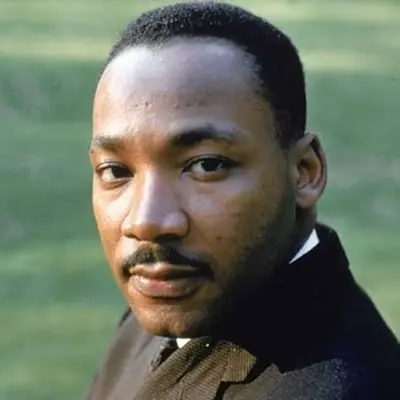
Martin Luther King Jr.
Capricorn
Who Was Martin Luther King Jr.?
Martin Luther King Jr. was a social activist and Baptist minister who played a key role in the American Civil Rights Movement from the mid-1950s until his assassination in 1968. He sought equality and human rights for African Americans, the economically disadvantaged, and all victims of injustice — through peaceful protest.
During the less than 13 years of Dr. King’s leadership of the modern American Civil Rights Movement, African Americans achieved more genuine progress toward racial equality in America than the previous 350 years had produced.
Therefore, understanding his life is not just a history lesson. It is a blueprint for justice itself.
Early Life: Born Into a Legacy of Faith
A Home on Auburn Avenue
Martin Luther King Jr. was born at noon on Tuesday, January 15, 1929, at the family home at 501 Auburn Avenue, N.E., Atlanta, Georgia.
King came from a comfortable middle-class family steeped in the tradition of the Southern Black ministry. Both his father and maternal grandfather were Baptist preachers. His parents were college-educated, and King’s father had succeeded his father-in-law as pastor of the prestigious Ebenezer Baptist Church in Atlanta.
Family Roots
Martin Luther King Jr. was the first son and second child of the Reverend Martin Luther King Sr. and Alberta Williams King. His siblings were Christine King Farris and the late Reverend Alfred Daniel Williams King.
His family name itself carries a powerful story. Martin Luther King Sr. was originally named Michael King but was inspired after a trip to Germany to formally change his name — and that of his son — to Martin Luther. The name was a tribute to the great German Protestant reformer. It would prove prophetic.
A Gifted Student Who Skipped Grades
King attended segregated public schools in Georgia and excelled academically, skipping grades 9 and 12 before enrolling in Morehouse College at the age of 15. He graduated with a bachelor’s degree in sociology in 1948.
During his time at Morehouse College, King was exposed to the teachings of Mahatma Gandhi and became deeply committed to nonviolent resistance as a means of achieving social change.
He did not stop there. Furthermore, he went on to earn a Bachelor of Divinity degree from Crozer Theological Seminary in Pennsylvania and a Doctor of Philosophy degree from Boston University.
Love and Marriage: Coretta Scott King
A Meeting in Boston
In 1952, while attending Boston University, Martin Luther King Jr. was introduced to his future wife, Coretta Scott, who was attending the New England Conservatory to study music.
While initially wary of dating a Baptist minister, she was impressed by his sophistication and intellect. King reportedly told her: “You have everything I have ever wanted in a wife.”
The couple was married on June 18, 1953. The marriage ceremony took place on the lawn of the Scotts’ home in Marion, Alabama.
Four Children, One Shared Mission
The couple raised four children: Yolanda Denise King (1955), Martin Luther King III (1957), Dexter Scott King (1961), and Bernice Albertine King (1963).
Although Coretta Scott King was focused on raising their four children, she continued to play a critical role in many civil rights campaigns of the 1950s and 1960s. She performed in freedom concerts that included poetry recitation, singing, and lectures related to the civil rights movement.
Together, they were not just a couple. They were a movement.
The Civil Rights Career: A Fight for Justice
The Montgomery Bus Boycott (1955–1956): The Spark That Started Everything
King’s leadership came to the forefront during the Montgomery Bus Boycott in 1955–1956, sparked by Rosa Parks’ refusal to give up her bus seat to a white person.
King’s prominent and outspoken role in the boycott led to numerous threats against his life, and his house was firebombed. He was arrested during the campaign.
Nevertheless, he did not back down. The campaign concluded with a United States District Court ruling in Browder v. Gayle that ended racial segregation on all Montgomery public buses. King’s role in the bus boycott transformed him into a national figure and the best-known spokesman of the civil rights movement.
Founding the SCLC (1957)
In 1957, King, Ralph Abernathy, Fred Shuttlesworth, Joseph Lowery, and other civil rights activists founded the Southern Christian Leadership Conference to harness the organizing power of Black churches and conduct nonviolent protests to ultimately achieve civil rights reform.
The SCLC motto was “Not one hair of one head of one person should be harmed.” King would remain at the helm of this influential organization until his death.
Birmingham Campaign and the Letter from Birmingham Jail (1963)
In 1963, King took the movement to Birmingham, Alabama — one of the most segregated cities in America.
King and the SCLC joined the local movement in Birmingham in 1963 to implement nonviolent direct action protesting discriminatory laws. After he was arrested for that work, he wrote his “Letter from Birmingham Jail,” directed at local clergy questioning the protests.
He wrote the letter primarily in response to a group of white clergymen who had criticized the tactics of the protestors.
His arrest in Birmingham and the publication of his “Letter from Birmingham Jail” established him as a national moral voice who called for conscience to guide public life and for concrete legal and social reform.
It remains one of the most powerful documents in American history. It is still read in classrooms and courtrooms around the world.
The March on Washington and “I Have a Dream” (August 28, 1963)
Then came the moment that defined a generation.
On August 28, 1963, King participated in the March on Washington for Jobs and Freedom. From the steps of the Lincoln Memorial, he delivered his famous “I Have a Dream” speech to a crowd of 250,000.
His most famous work is his “I Have a Dream” speech, delivered in 1963, in which he spoke of his dream of a United States that is free of segregation and racism.
Because of his work, in 1964 King received the Nobel Peace Prize. He was the youngest person ever to receive this high honor.
The Civil Rights Act (1964) and Voting Rights Act (1965)
The marches were not just symbols. They produced real, lasting change.
The Montgomery Bus Boycott integrated Alabama’s public transit. The Greensboro Sit-In movement desegregated lunch counters across the South. The March on Washington led to the passage of the 1964 Civil Rights Act. The Selma-to-Montgomery marches helped bring about the Voting Rights Act of 1965.
King’s leadership played a pivotal role in ending entrenched segregation for African Americans and in the creation of the Civil Rights Act of 1964, considered a crowning achievement of the civil rights era.
Selma to Montgomery (1965): The Arc of Justice
During the march from Selma to Montgomery on March 25, 1965, King declared: “The arc of the moral universe is long, but it bends toward justice.”
Those words became one of the most quoted statements in American public life. They carry a truth that transcends time.
Opposition to the Vietnam War (1967)
By 1967, King had expanded his vision beyond race. He spoke out against war and poverty with equal courage.
On April 15, 1967, King spoke against the Vietnam War, stating: “I would like to see the fervor of the civil-rights movement imbued into the peace movement.”
This was a bold stand. It cost him support among some political allies. However, King believed that justice could not be divided into separate causes. Justice had to be whole — or it was nothing at all.
The Nobel Peace Prize: Recognized by the World
In 1964, King was awarded the Nobel Peace Prize. At the time, he was the youngest person to have done so.
In the presentation speech, Nobel Committee Chairman Gunnar Jahn said of King: “He is the first person in the Western world to have shown us that a struggle can be waged without violence. He is the first to make the message of brotherly love a reality in the course of his struggle, and he has brought this message to all men, to all nations and races.”
Moreover, King was honored with dozens of awards and honorary degrees for his achievements throughout his life and posthumously.
The Assassination: April 4, 1968
Memphis and the Sanitation Workers’ Strike
King’s final days were spent in the service of others — as they always had been.
In the spring of 1968, King visited Memphis, Tennessee, to support Black sanitary workers who were on strike. He was in Memphis to support African American sanitation workers who were striking to protest unequal wages and working conditions.
The Fatal Shot
On April 4, 1968, at 6:01 p.m., Dr. King was shot once while standing on an open balcony in front of Room 306 on the second floor of the Lorraine Motel. Rushed to nearby St. Joseph Hospital, Dr. King was pronounced dead at 7:05 p.m.
He was just 39 years old.
President Johnson called for a national day of mourning on April 7. His assassin, James Earl Ray, at first escaped, but was captured at London’s Heathrow Airport in June 1968. Sentenced to a 99-year jail term, he died in prison in 1998.
The world grieved. And then, the world carried on his dream.
Legacy: A Dream That Lives On
Martin Luther King Jr. Day
The idea to make King’s birthday a national holiday came just four days after his assassination, when Representative John Conyers first proposed a bill memorializing the day. However, it took more than a decade before the proposal even made it to the U.S. House floor.
Finally, in 1983, President Ronald Reagan signed the legislation into law. Three years later, the first federal observance of Martin Luther King Jr. Day was held on January 20, 1986.
The King Center
Coretta Scott King founded the Martin Luther King Jr. Center for Nonviolent Social Change in 1968. Today, it stands as a living monument to his life’s work — a place of education, activism, and hope.
Words That Outlive Time
Dr. King is widely regarded as America’s pre-eminent advocate of nonviolence and one of the greatest nonviolent leaders in world history.
Over the years, extensive archival studies have led to a more balanced and comprehensive assessment of King’s life, portraying him as a complex figure — flawed, fallible, and limited in his control over mass movements — yet a visionary leader who was deeply committed to achieving social justice through nonviolent means.
His dream was not a fantasy. It was a demand.
Key Events Timeline
| Year | Event |
|---|---|
| 1929 | Born in Atlanta, Georgia |
| 1944 | Graduates Booker T. Washington High School |
| 1948 | Graduates Morehouse College (BA, Sociology) |
| 1951 | Graduates Crozer Theological Seminary (B.Div) |
| 1953 | Marries Coretta Scott |
| 1955 | Earns PhD from Boston University; leads Montgomery Bus Boycott |
| 1957 | Co-founds the SCLC |
| 1963 | Birmingham Campaign; Letter from Birmingham Jail; “I Have a Dream” speech |
| 1964 | Civil Rights Act passed; awarded Nobel Peace Prize |
| 1965 | Selma-to-Montgomery marches; Voting Rights Act passed |
| 1967 | Speaks out against Vietnam War |
| 1968 | Assassinated at Lorraine Motel, Memphis (April 4) |
| 1983 | MLK Day signed into law by President Reagan |
| 1986 | First federal observance of Martin Luther King Jr. Day |