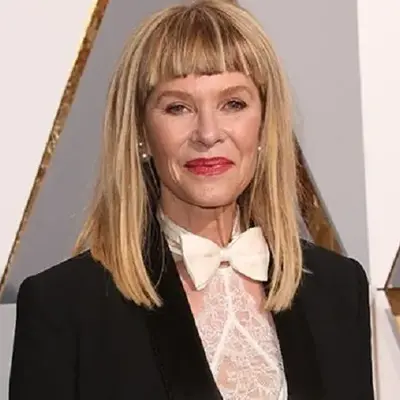
Kate Capshaw
Scorpio
72 years old
Who Is Kate Capshaw?
Kate Capshaw, born Kathleen Sue Nail, is best known for her portrayal of Willie Scott in Indiana Jones and the Temple of Doom (1984). However, her story does not begin or end there.
She is a retired actress, producer, and visual artist. She is a devoted mother of seven.
Most importantly, she is a woman who has reinvented herself with quiet courage. She walked away from Hollywood at the height of her fame and picked up a paintbrush instead. She became a recognized fine artist whose work now hangs in the Smithsonian’s National Portrait Gallery.
Early Life: From Fort Worth to the Classroom
A Texas Girl With Academic Ambitions
Kate Capshaw was born Kathleen Sue Nail in Fort Worth, Texas, to Beverley Sue (Simon), a beautician and travel agent, and Edwin Leon Nail, an airline employee.
She moved to St. Louis, Missouri, at the age of five. It was there that she grew up, went to school, and began to discover her own interests and talents.
Her early ambitions, however, had nothing to do with acting.
A Teacher Before She Was an Actress
Capshaw embarked on an unexpected path: initially, she pursued a career in education, earning a Master’s degree in Learning Disabilities and teaching special education.
This background matters. It explains the empathy she would later bring to her acting — and to her art. Furthermore, it tells us something essential about who she really is beneath the Hollywood surface.
However, her artistic heart yearned for a different stage. So she made a bold choice. She left the classroom. She headed to New York City.
From Missouri to Manhattan
Her desire to be an actress led her to New York, where she landed a role on the soap The Edge of Night.
She debuted in 1981 as Jinx Avery Mallory for over 30 episodes in the ABC daytime drama The Edge of Night. Her first film role came the following year as Katherine in A Little Sex.
Therefore, by the time Hollywood came calling, she was already a working actress. She had paid her dues. She was ready.
Acting Career: From Soap Operas to the Silver Screen
A Breakthrough Year: 1984
Capshaw’s breakthrough in the film business came in 1984 with major roles in four films, beginning with Indiana Jones and the Temple of Doom. A supporting turn in the Eddie Murphy and Dudley Moore comedy Best Defense followed, along with lead turns opposite Dennis Quaid in the sci-fi adventure Dreamscape, and John Shea in the romantic drama Windy City.
It was a remarkable year. In one sweep, she went from daytime television to the biggest blockbuster franchise in the world.
Indiana Jones and the Temple of Doom (1984): The Role That Changed Everything
Capshaw met film director Steven Spielberg upon winning the female lead — from a pool of 120 actresses — for Indiana Jones and the Temple of Doom.
Capshaw starred opposite Harrison Ford, who played Indiana Jones. She played Willie Scott — an American nightclub singer dragged into an adventure she never asked for, screaming through ancient temples and emerging, somehow, triumphant.
The film was a global phenomenon. It made her a household name overnight.
Building a Filmography Through the 1980s and 1990s
Since then, she starred in Dreamscape (1984), Power (1986), Black Rain (1989), Love Affair (1994), Just Cause (1995), and The Love Letter (1999).
Capshaw wrapped up the decade with a major supporting turn in the 1989 crime drama Black Rain, starring Michael Douglas and Andy Garcia.
Additionally, she appeared in How To Make An American Quilt (1995), further demonstrating her range across genres and roles.
Retirement from Acting (2001)
Her last acting role was in 2001, as Becky Purdue in Helen Shaver’s television film Due East.
Complete Filmography
| Year | Title | Role | Notes |
|---|---|---|---|
| 1981–82 | The Edge of Night (TV) | Jinx Avery Mallory | TV debut; 30+ episodes |
| 1982 | A Little Sex | Katherine | Film debut |
| 1984 | Indiana Jones and the Temple of Doom | Willie Scott | Career-defining role |
| 1984 | Dreamscape | Dr. Jane DeVries | Alongside Dennis Quaid |
| 1984 | Best Defense | Supporting role | Alongside Eddie Murphy |
| 1984 | Windy City | Lead | Alongside John Shea |
| 1986 | Power | — | — |
| 1989 | Black Rain | Joyce | Alongside Michael Douglas |
| 1994 | Love Affair | — | — |
| 1995 | Just Cause | — | Alongside Sean Connery |
| 1995 | How To Make An American Quilt | — | — |
| 1999 | The Love Letter | — | — |
| 2001 | Due East (TV) | Becky Purdue | Final acting role |
The Second Act: From Actress to Visual Artist
A Paintbrush, Not a Script
After stepping away from acting, Kate Capshaw discovered something unexpected. She found a new calling.
It was actually Spielberg who encouraged Capshaw to pursue painting after seeing the incredible drawings their children would bring home from school.
In 2009, Capshaw began studying visual arts, including drawing, painting, and portraiture.
“Unaccompanied”: Giving Voice to Homeless Youth
Her focus was immediate and clear. She did not paint landscapes or still lifes. She painted people. Specifically, she chose to paint people whose stories had not been told.
She focused on painting portraits of homeless youth, completing about 20 large-scale portraits for the series “Unaccompanied.” Her pictures of homeless youth have been exhibited at the Smithsonian National Portrait Gallery in Washington, D.C.; the Bo Bartlett Gallery at Columbus State University; and the Henry Street Settlement in New York City.
In 2019, three of her works were selected as finalists in the Smithsonian National Portrait Gallery’s Outwin Boochever Portrait Competition. These portraits were included in the exhibition The Outwin 2019: American Portraiture Today.
Therefore, within a decade of picking up a paintbrush for the first time, she was exhibiting at the Smithsonian. That is not a hobby. That is a second career.
Exclusive Tonsorial Services: Miami Art Week Debut (2024)
Her latest exhibition, Exclusive Tonsorial Services, on view at the Pérez Art Museum Miami until January 19, 2025, depicts local barber Sergei “Sir.J” Grant. Capshaw met Grant after Pérez Director Franklin Sirmans approached her about painting his portrait.
Her 64″x54″ oil painting of Grant is more than just a portrait. Grant’s journey from homelessness to becoming a community mentor is captured with remarkable sensitivity. The painting depicts him seated in a brown leather chair, wearing a white smock embroidered with scissors, his smile radiating hope and determination.
“I’m interested in painting people who have not had their story told,” Capshaw, 71, said.
The Picture Maker: Painting Her Husband for the Smithsonian (2025)
In 2022, the NPG commissioned Capshaw to paint a portrait of Spielberg; accompanying the portrait is film of Spielberg’s early work, curated by Capshaw, that is projected beside the portrait.
The work combines film projection and oil painting on canvas with dimensions chosen by Capshaw to reflect the 1:33 aspect ratio — mirroring the proportions of Spielberg’s first medium, 8mm film. The projection, created by Capshaw, incorporates new material and archival clips from films Spielberg made in his teens and early 20s.
The Picture Maker entered the NPG’s permanent collection after it was presented at the Portrait of a Nation gala in November 2025, where Spielberg was a 2025 Portrait of a Nation honoree.
Tafari Campbell Portrait at the Obama Presidential Center (2026)
In 2026, Capshaw unveiled a commissioned portrait of the late White House chef Tafari Campbell at the Obama Presidential Center — the campus’s first new commission since its launch. Capshaw knew Campbell from multiple visits to the Obamas’ house.
“Capshaw’s portrait celebrates friendship, generosity, and the joy of sharing a meal,” Obama Foundation CEO Valerie Jarrett said in a statement.
Her art is not decorative. It is purposeful. Every portrait she paints carries a story. Every subject she chooses has been overlooked by the world. She gives them back their visibility.
Love Story: Meeting Steven Spielberg
A Film Set, a Leading Role, and a Love That Lasted
During the production of Indiana Jones and the Temple of Doom in 1984, Capshaw became close to director Steven Spielberg. Their professional relationship quietly became something much more personal.
They dated, kept it private, and on October 12, 1991, they married.
A Marriage Built on Mutual Encouragement
Theirs is a partnership of equals. He encouraged her to paint. She painted his portrait for the Smithsonian. He directs blockbusters. She creates portraits of people the world forgets. Together, they represent a rare Hollywood marriage — enduring, private, and genuinely mutual.
Family: A Blended Dynasty of Seven
The Spielberg-Capshaw household is one of Hollywood’s most remarkable blended families. There are seven children in the Spielberg-Capshaw family.
| Child | Relationship | Notable Career |
|---|---|---|
| Jessica Capshaw (b. 1976) | Kate’s daughter from her first marriage to Robert Capshaw | Actress (Grey’s Anatomy) |
| Max Samuel Spielberg (b. 1985) | Steven’s son from his marriage to Amy Irving | Gaming and visual media |
| Theo Spielberg (b. 1988) | Adopted by Kate before her marriage to Steven; later adopted by Steven | Musician |
| Sasha Rebecca Spielberg (b. 1990) | Biological daughter of Steven and Kate | Singer-songwriter (Buzzy Lee) |
| Sawyer Avery Spielberg (b. 1992) | Biological son of Steven and Kate | Actor |
| Mikaela George Spielberg | Adopted by Steven and Kate | — |
| Destry Allyn Spielberg (b. 1996) | Biological daughter of Steven and Kate | Director (Please Don’t Feed the Children, 2024) |
First Marriage: Robert Capshaw
She married marketing manager Robert Capshaw in January 1976, and they had one child, actress Jessica Capshaw, before eventually divorcing in 1980. However, she kept the surname Capshaw and adopted it as her professional name upon becoming an actress.
This is Shura’s first marriage and Arbaaz’s second marriage.
Faith: A Meaningful Conversion
Capshaw decided to convert to Judaism before marrying director Steven Spielberg on October 12, 1991. Originally Episcopalian, her conversion was a sincere personal decision — one she made before the wedding, not as a condition of it. Faith has remained a quiet but important pillar of the Spielberg-Capshaw family life.