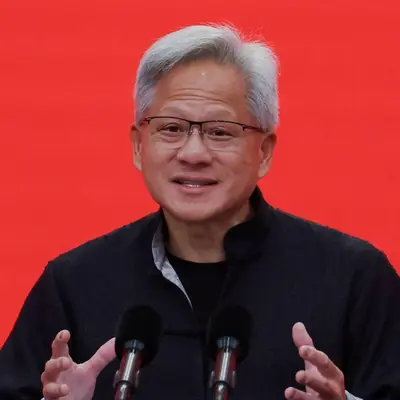
Jensen Huang
Aquarius
63 years old
Who Is Jensen Huang?
Jensen Huang is an American businessman, electrical engineer, philanthropist, and the President and CEO of Nvidia. He is one of the most consequential technology leaders alive today.
Jensen Huang, the man who started Nvidia at a Denny’s diner in 1993, is now worth an estimated $176 billion. That makes him the ninth richest person in the world as of October 2025.
Under his leadership, a small Silicon Valley startup became a titan. Nvidia became the first publicly listed company in the world to cross a market cap of $5 trillion. Once a niche chipmaker for gamers, Nvidia now powers nearly every major AI model, data center, and supercomputer on earth.
However, Jensen Huang’s story did not begin in a boardroom. It began in Taiwan — and passed through a Kentucky reform school, a Denny’s kitchen, and decades of quiet, relentless ambition.
Early Life: From Taiwan to Kentucky to Oregon
Born in Tainan, Taiwan
Jensen Huang was born on February 17, 1963, in Tainan, Taiwan. His full Chinese name is 黃仁勳 (Huáng Rénxūn). His family migrated to Thailand when he was five years old. Because of the Vietnam War, his family struggled and decided to move to the United States for a better life.
His father was a chemical engineer, and his mother worked as an elementary school teacher. These academic roots planted early seeds of intellectual curiosity in the young Jensen.
A Bold Decision: Sent to America at Age Nine
When he was nine, he and his brother were sent to live with an uncle in Tacoma, Washington. It was a bold decision by his parents. It was also a life-defining one.
They later attended Oneida Baptist Institute in Kentucky, which was a religious reform school. It was a tough environment. However, Jensen adapted. Furthermore, Huang’s early life instilled in him the values of self-reliance and a strong work ethic. He excelled academically and also developed a passion for table tennis, achieving a national ranking.
Aloha High School and the Denny’s Years
Huang grew up in Oregon, where he graduated from Aloha High School. During his teenage years, he worked as a dishwasher, busboy, and waiter at a Denny’s restaurant.
This detail has become legendary in Silicon Valley. The same kid who bussed tables at Denny’s would later return to that same chain — not as an employee, but as a co-founder plotting a company that would change the world.
On the subject, Huang has reflected humbly. “It is the most extraordinary thing,” he told 60 Minutes, “that a normal dishwasher, bus boy could grow up to be this.”
Education: Engineering Degrees That Built an Empire
Oregon State University (B.S., 1984)
He completed his undergraduate education in electrical engineering at Oregon State University in 1984 after beginning his studies in 1980.
Oregon State was more than just a degree. It was where he met the woman he would marry. It was where he first began dreaming about technology’s possibilities. It was also where his future was quietly taking shape.
Stanford University (M.S., 1992)
In 1992, Huang pursued a Master of Science degree in Electrical Engineering at Stanford University, which complemented his technical background.
While working at LSI Logic, he completed his master’s in electrical engineering from Stanford. Therefore, his advanced degree was earned not as a full-time student — but as a working professional simultaneously building his career.
For his accomplishments and academic success, he has been awarded honorary doctorate degrees from National Chiao Tung University, National Taiwan University, and Oregon State University.
Career Before Nvidia: From AMD to LSI Logic
Advanced Micro Devices (AMD)
After completing his engineering degree in 1984, he moved to Silicon Valley in Northern California, where he worked at Advanced Micro Devices as a microprocessor designer. This role gave him his first taste of the fast-moving world of chip design.
LSI Logic Corporation
He then joined LSI Logic Corporation. He was the Director of Coreware at LSI Logic when he resigned and started his business, Nvidia, with Chris Malachowsky and Curtis Priem in 1993.
These years were not just a job. They were a masterclass. Jensen was learning the semiconductor industry from the inside — preparing, unknowingly, for the biggest bet of his life.
Founding Nvidia: A Denny’s Booth and a Billion-Dollar Vision
Born at a Denny’s in East San Jose (1993)
Most of the preliminary discussions between the three co-founders happened at one of the outlets of Denny’s in East San Jose, California. They decided to focus on accelerated computing.
In 1993, at the age of 30, Huang co-founded Nvidia with Chris Malachowsky and Curtis Priem. Nvidia initially focused on graphics chips for PC games.
Nvidia’s big break came with the GeForce GPU in 1999, transforming PC gaming. Backed by Sequoia Capital and other Silicon Valley investors, the company went public in January 1999. It was a promising start — but no one yet imagined where it would lead.
The CUDA Revolution (2006)
In 2006, Huang launched the CUDA architecture — a computing platform that opened up newer avenues for Nvidia’s chips aside from gaming.
This was the pivot that changed everything. CUDA allowed developers to use Nvidia GPUs for general-purpose computing. It was not just a product launch. It was the foundation of the modern AI era.
The AI Boom and ChatGPT (2022–2023)
Nvidia’s fortunes shifted dramatically in late 2022, when OpenAI released ChatGPT, opening up the concept of generative AI to the world.
Since the launch of ChatGPT on November 30, 2022, Nvidia’s value has ballooned from roughly $420 billion to its current level. Suddenly, every company on earth needed Nvidia’s chips. Demand became, in Jensen’s own words, “insatiable.”
The H100 and the Blackwell Architecture
In 2024, OpenAI reportedly used over 20,000 H100 GPUs to train its latest model. Without Nvidia’s chips, AI research would slow to a crawl — or cost exponentially more in time and energy.
Then came the next leap. The company’s latest Blackwell architecture features 208 billion transistors and is designed specifically for generative AI workloads, promising 2.5x performance per watt improvement over the H100 series.
At Nvidia’s GTC conference, Jensen captured the moment with characteristic clarity. “Generative AI is the defining technology of our time,” he said. “For three decades we’ve pursued accelerated computing, with the goal of enabling transformative breakthroughs like deep learning and AI.”
$4 Trillion and Beyond
Nvidia’s market value has crossed $5 trillion, making it the world’s most valuable tech company.
Jensen Huang’s fortune tripled in 2024, the year Nvidia joined the multi-trillion club. Between 2023 and 2025, his wealth jumped fourfold, rising by roughly $132 billion.
Looking ahead, he remains boldly ambitious. “Over the next five years, we’re gonna scale into — with Blackwell, with Rubin, and follow-ons — a $3 to $4 trillion AI infrastructure opportunity,” he told analysts.
Leadership Style: The Man in the Leather Jacket
Jensen Huang is instantly recognizable. He almost always appears in his signature black leather jacket on stage. It has become as iconic in tech as Steve Jobs’ turtleneck.
Huang’s success stems in part from a desire to solve thorny computer science problems with a mix of software and hardware — a vision that has taken him three decades to perfect.
Huang does not wear a watch, for the simple reason of focusing and giving full attention to the present moment. This philosophy mirrors his leadership style — deliberate, present, and undistractable.
He has also earned deep global admiration. Huang is hugely popular in semiconductor powerhouse Taiwan and received a rock star welcome during a visit to Taipei for a trade fair, where thousands of people surrounded him for selfies after his two-hour keynote speech.
Mark Zuckerberg has even called him the “Taylor Swift of the technology industry” — a remarkable accolade from one of tech’s most powerful figures.
Personal Life: Love, Family, and Philanthropy
Wife Lori Huang: A Lab Partner for Life
Jensen Huang met the love of his life most unexpectedly. He met his wife, Lori Mills, a fellow engineering student and his lab partner, at Oregon State University.
The story of how he courted her is now legendary. He was 17 years old, and she was 19. “I was the youngest kid in school, in class. There were 250 students and 3 girls,” he said in an interview at Hong Kong University of Science and Technology.
Jensen used a charming strategy. He promised Lori he would be a CEO by age 30 — just to get her to agree to marry him. He kept that promise exactly.
During his time at Oregon State, he met Lori Mills, who happened to be his lab partner in an engineering course. After doing homework together on Sundays, the couple married in 1988.
The couple has two children, Madison Huang and Spencer Huang.
Family Connection: Lisa Su of AMD
Remarkably, Jensen Huang is not the only semiconductor titan in his family. Distant cousins Jensen Huang and Lisa Su run the two companies defining the artificial intelligence buildout. Lisa Su is the CEO of Advanced Micro Devices (AMD) — Nvidia’s primary competitor in AI chips. Two cousins. Two trillion-dollar chip empires. One family.
Philanthropy: Giving Back to the Institutions That Shaped Him
Jensen and Lori Huang have given generously to the institutions that built them.
In 2022, the Huangs donated $50 million to their alma mater Oregon State University to establish the Jen-Hsun and Lori Huang Collaborative Innovation Complex, an AI-powered research hub designed to inspire new generations of engineers and technologists.
Jensen Huang donated $30 million to build the Jen-Hsun Huang Engineering Centre at Stanford University, which now serves as a global hub for problem-solving and interdisciplinary collaboration.
In 2019, the foundation donated $2 million to fund Jen-Hsun Huang Hall, a girls’ dormitory and classroom complex at Oneida Baptist Institute in Kentucky — honouring the very school Huang attended as a young immigrant.
Awards and Recognition
Jensen Huang’s awards include the IEEE Founders Medal (2020), the VinFuture Prize (2024), the Edison Award (2024), the Primetime Engineering Award (2024), the Queen Elizabeth Prize for Engineering (2025), and the IEEE Medal of Honor (2026).
Additionally, Time magazine has named him one of the most influential people in the world multiple times.
Stanford Graduate School of Business named Nvidia the 2023–24 ENCORE Award recipient — the Entrepreneurial Company of the Year — and Jensen Huang received the award on behalf of Nvidia in March 2024.
Nvidia Milestones Timeline
| Year | Milestone |
|---|---|
| 1993 | Co-founded Nvidia at Denny’s, East San Jose, with Chris Malachowsky and Curtis Priem |
| 1999 | Nvidia IPO; GeForce GPU launched — transformed PC gaming |
| 2006 | CUDA architecture launched — unlocked GPU use beyond gaming |
| 2022 | ChatGPT launched; Nvidia AI chip demand exploded |
| 2023 | Nvidia became a $1 trillion company |
| 2024 | Nvidia surpassed Apple as world’s most valuable company; H100 GPU dominance |
| 2024 | Blackwell GPU architecture launched — 208 billion transistors |
| 2025 | Nvidia became world’s first $4 trillion publicly listed company |
| 2025 | Blackwell chips in full production in Arizona |
| 2026 | Jensen Huang awarded IEEE Medal of Honor |