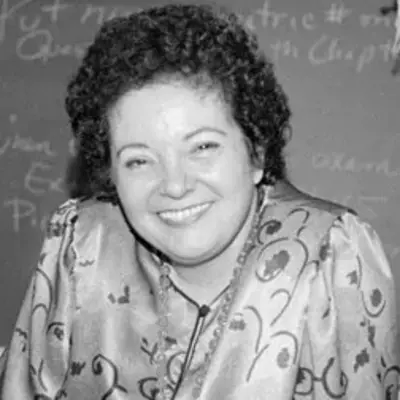
Paula Gunn Allen
Scorpio
Who Was Paula Gunn Allen?
Paula Gunn Allen was born Paula Marie Francis on October 24, 1939, in Cubero, New Mexico. She died on May 29, 2008, in Fort Bragg, California, at the age of 68.
She was a poet, novelist, literary critic, scholar, activist, and professor. Over a career spanning five decades, she published 17 books — poetry collections, critical essays, anthologies, fiction, and biography. She received an American Book Award in 1990 and the Modern Language Association’s Hubbell Medal in 1999.
Paula called herself “a multi-cultural event.” Her mother, Ethel Haines Francis, was of Laguna Pueblo, Sioux, and Scottish ancestry. Her father, Elias Lee Francis, was Lebanese-American, owned the Cubero Trading Company, and served as Lieutenant Governor of New Mexico from 1967 to 1970.
Paula cousin is novelist Leslie Marmon Silko. Her sister is poet Carol Lee Sanchez. Her brother, Lee Francis, was a Laguna Pueblo-Anishinaabe poet and storyteller.
Early Life: Cubero, New Mexico
Paula grew up in Cubero — a Spanish-Mexican land grant village 50 miles west of Albuquerque, bordering the Laguna Pueblo reservation. She spent part of her childhood among the Laguna people and identified closely with that community throughout her life.
Her early education took place at mission and boarding schools. She graduated from Sisters of Charity, a religious boarding school just outside Albuquerque, in 1957. Both her parents were musicians. The household she grew up in sat at the intersection of four cultures — Pueblo, Sioux, Lebanese, and Scottish — and that intersection shaped every book she wrote.
Education: Oregon, Marriage, and New Mexico
Allen left New Mexico for the University of Oregon, where she studied under poet Ralph Salisbury. She earned a BA in English in 1966 and an MFA in Creative Writing in 1968 — both from Oregon.
Between her early college years and her return to academia, she married and divorced, raising two children. She returned to New Mexico and earned her PhD in American Studies at the University of New Mexico in 1975, where she began her research into tribal religions.
Academic Career: From Fort Lewis to UCLA
Allen taught at Fort Lewis College in Durango, Colorado, then at San Francisco State University, where she directed the Native American Studies program. She held positions at the University of New Mexico and the University of California, Berkeley, before joining UCLA in 1990. She taught in UCLA’s English department and the UCLA American Indian Studies Center until her retirement in 1999.
A colleague at UCLA described her as “one of the most widely respected and accomplished scholars and writers in the history of American Indian Studies in this country.”
Career Highlights: 17 Books and a Field Transformed
The Sacred Hoop (1986)
Allen’s most influential work is The Sacred Hoop: Recovering the Feminine in American Indian Traditions, published by Beacon Press in 1986. The book argued that pre-colonial Native American societies were woman-centered and matrilineal, and that European colonizers had deliberately suppressed that record. It became a cornerstone text in both Native American Studies and feminist scholarship.
The book drew controversy. Mainstream scholars and some Indigenous critics challenged its arguments. Nevertheless, it established itself as a classic in the field and appeared on syllabi across North America throughout the 1990s and 2000s.
Spider Woman’s Granddaughters (1989)
Allen edited Spider Woman’s Granddaughters: Traditional Tales and Contemporary Writing by Native American Women in 1989. The anthology collected 100 years of Native American women’s writing — traditional tales, biographical pieces, and short stories — and gave many Native writers their first mainstream publication. It won the American Book Award from the Before Columbus Foundation in 1990.
The Woman Who Owned the Shadows (1983)
Her novel The Woman Who Owned the Shadows, published in 1983, follows Ephanie Atencio, a contemporary Native American woman navigating identity and survival. It draws on Pueblo oral tradition and stands as one of the earliest novels by a Native American woman to address lesbian identity directly.
Poetry
Allen published seven volumes of poetry. Life Is a Fatal Disease: Collected Poems 1962–1995 (West End Press, 1997) gathered three decades of her verse. Skins and Bones: Poems 1979–1987 (West End Press, 1988) is among her most widely read collections. Her poem “Grandmother” appeared in Rita Dove’s Penguin Anthology of Twentieth-Century American Poetry (2011), three years after Allen’s death.
Pocahontas: Medicine Woman, Spy, Entrepreneur, Diplomat (2003)
Allen’s final major work reexamined the life of Pocahontas, dismantling stereotypes reinforced by popular culture — including the 1995 Disney film. It received a Pulitzer Prize nomination.
Anthologies
Allen edited three major anthologies that mapped the landscape of Native American writing for students and scholars:
- Voice of the Turtle: American Indian Literature, 1900–1970 (1994)
- Song of the Turtle: American Indian Literature, 1974–1994 (1996)
- Hozho: Walking in Beauty: Native American Stories of Inspiration, Humor, and Life (2001, co-edited with Carolyn Dunn Anderson)
Scholarly Influence: A Field That Did Not Exist
When Allen began her academic career, most universities did not recognize Native American literature as a field of study. She taught courses, edited anthologies, wrote criticism, and lobbied institutions until the field had a body of texts, a critical vocabulary, and a place in American literature departments.
“When the field of native literature blew open in the later seventies,” a colleague wrote after her death, “Paula was there to help anchor its place in the academy.”
Her 1981–82 postdoctoral fellowship at UCLA preceded her full-time appointment there by nearly a decade. During that period, she held positions at UC Berkeley and continued writing and publishing. She never stopped producing work while building the institutional framework that would support the writers who came after her.
Activism
Allen was a public activist throughout her career — around feminism, gay and lesbian rights, and the antiwar and antinuclear movements. She was openly lesbian and wrote about sexuality and Indigenous identity at a time when both were largely absent from mainstream American literary discourse. She described herself as a poet, essayist, novelist, activist, teacher, woman, lesbian, and Laguna Pueblo-Sioux — in that order, listing identities rather than ranking them.
Awards and Honors
| Year | Award |
|---|---|
| 1967 | Julia Burgess Prize for Poetry |
| 1989 | Susan Koppelman Award, American Culture Association |
| 1990 | American Book Award, Before Columbus Foundation (Spider Woman’s Granddaughters) |
| 1999 | Hubbell Medal for Lifetime Achievement in American Literary Studies, Modern Language Association |
| 2007 | Lannan Literary Fellowship |
Death
Allen died of lung cancer on May 29, 2008, in Fort Bragg, California. She was 68. She was survived by her two children.
Full Bibliography
Criticism and Essays
- The Sacred Hoop: Recovering the Feminine in American Indian Traditions (Beacon Press, 1986)
- Off the Reservation: Reflections on Boundary-Busting, Border-Crossing, Loose Canons (Beacon Press, 1998)
- Grandmothers of the Light: A Medicine Woman’s Sourcebook (Beacon Press, 1991)
Novel
- The Woman Who Owned the Shadows (Spinsters Ink, 1983)
Poetry
- Life Is a Fatal Disease: Collected Poems 1962–1995 (West End Press, 1997)
- Skins and Bones: Poems 1979–1987 (West End Press, 1988)
- America the Beautiful (West End Press, 2010, posthumous)
Biography
- Pocahontas: Medicine Woman, Spy, Entrepreneur, Diplomat (HarperOne, 2003)
Anthologies Edited
- Spider Woman’s Granddaughters: Traditional Tales and Contemporary Writing by Native American Women (Beacon Press, 1989) — American Book Award, 1990
- Voice of the Turtle: American Indian Literature, 1900–1970 (Ballantine Books, 1994)
- Song of the Turtle: American Indian Literature, 1974–1994 (Ballantine Books, 1996)
- Hozho: Walking in Beauty: Native American Stories of Inspiration, Humor, and Life (Contemporary Books, 2001) — co-edited with Carolyn Dunn Anderson