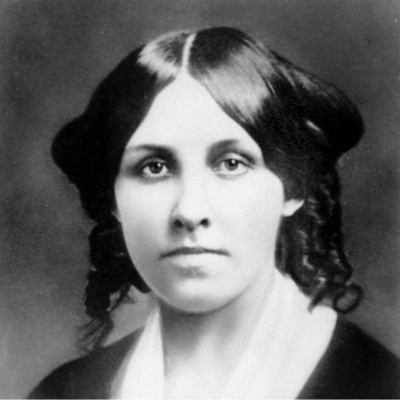
Louisa May Alcott
Sagittarius
Who Was Louisa May Alcott?
Louisa May Alcott (November 29, 1832 – March 6, 1888) was an American novelist, short story writer, and poet best known for writing Little Women (1868). She was also a committed abolitionist, feminist, and Civil War nurse who spent her life advocating for women’s suffrage and the end of slavery.
In her later life, Alcott became an advocate for women’s suffrage and was the first woman to register to vote in Concord, Massachusetts, in a school board election.
Louisa May Alcott wrote over 30 books and short-story collections and wrote poetry as well. Her work appeared under her real name and two pen names across four decades.
Early Life: Germantown, Boston, and Concord
Birth and Family
Louisa May Alcott was born on November 29, 1832, in Germantown, which is now part of Philadelphia, Pennsylvania, on her father’s 33rd birthday.
She was the second of four daughters, born to social worker Abby May and educator Amos Bronson Alcott. Her three sisters were Anna, Elizabeth Sewall, and Abigail May.
As a child, she was a tomboy who preferred boys’ games. The family moved to Boston in 1834, where Alcott’s father established the experimental Temple School and joined the Transcendental Club with Ralph Waldo Emerson and Henry David Thoreau.
Fruitlands and Financial Hardship
During Louisa’s early years, her father’s innovative Temple School in Boston failed, as did the family’s experiment with communal living with a group of transcendentalist mystics at Fruitlands, an early eighteenth-century farmhouse.
After the collapse of the Utopian Fruitlands, they rented rooms and finally, with Abigail May Alcott’s inheritance and financial help from Emerson, they purchased a homestead in Concord.
Alcott’s family experienced financial hardship, and while Alcott took on various jobs to help support the family from an early age, she also sought to earn money by writing.
Education: Thoreau, Emerson, and Hawthorne
Louisa May Alcott was educated mainly by her father, although Thoreau, Emerson, Nathaniel Hawthorne, and Margaret Fuller — all family friends — also gave her lessons.
In March 1840, the Alcott family moved to Concord. Louisa and her older sister Anna attended Concord Academy, which Henry Thoreau and his brother John ran between 1838 and 1841.
Early Writing Career: Flora Fairfield to A.M. Barnard
First Publications (1851–1854)
In 1851, her first poem, “Sunshine,” was published under the pen name Flora Fairfield in Peterson’s Magazine.
In 1854, at age 22, Alcott used her own name for the first time. She published Flower Fables, a collection of fairy tales she had written six years earlier for Emerson’s daughter, Ellen.
The A.M. Barnard Pen Name (1861–1863)
In 1862, she had begun using the pen name A.M. Barnard to write potboiler melodramas — a few of which were turned into plays and performed in Boston — strictly to earn money.
These sensational, melodramatic works are strikingly different from the more wholesome, righteous vibe she captured in Little Women, and she did not advertise her former writing as her own after Little Women became popular.
Civil War Service: Nurse in Washington, D.C.
Six Weeks at Union Hospital (1862–1863)
When the American Civil War broke out, she served as a nurse in Union Hospital in the Georgetown area of Washington, D.C., for six weeks in 1862–1863. She intended to serve three months as a nurse, but contracted typhoid fever and became deathly ill.
As a nurse, she suffered from mercury poisoning when she contracted typhoid fever, and doctors used calomel, which contained a large amount of mercury as a medicine. She felt the effects of this throughout her remaining years.
Hospital Sketches (1863)
It was her account of her Civil War experiences, Hospital Sketches (1863), that confirmed Alcott’s desire to be a serious writer.
It was during the Civil War that Alcott decided to become a serious writer and began to publish stories under her real name in Atlantic Monthly and Lady’s Companion.
Little Women and Literary Success
Writing the Novel (1868)
At the age of thirty-five, at her publisher’s request for a girls’ book, Louisa wrote Little Women from May to July 1868.
Published in 1868, Little Women is set in the Alcott family home, Orchard House, in Concord, Massachusetts, and is loosely based on Alcott’s childhood experiences with her three sisters, Abigail May Alcott Nieriker, Elizabeth Sewall Alcott, and Anna.
One of the notable characters was Jo March, the first young American heroine to act on individuality.
The Sequels: A March Family Saga
Part two, also known as Good Wives, followed the March sisters into adulthood and their respective marriages. Little Men detailed Jo’s life at the Plumfield School that she founded with her husband, Professor Bhaer, at the conclusion of Part Two of Little Women. Jo’s Boys completed the “March Family Saga.”
Three sequels followed: Good Wives (1869), Little Men (1871), and Jo’s Boys (1886).
The great success of Little Women gave Alcott financial independence and created a demand for more books.
Activism: Abolitionism and Women’s Suffrage
Alcott was not only a novelist. She was a campaigner.
She also spent her life active in reform movements such as temperance and women’s suffrage.
Throughout the fifties, Alcott became acquainted with the Underground Railroad and women’s rights issues. She was the first woman to register to vote in Concord, Massachusetts.
Alcott, along with Elizabeth Stoddard, Rebecca Harding Davis, Anne Moncure Crane, and others, was part of a group of female authors during the Gilded Age who addressed women’s issues in a modern and candid manner.
Death and Legacy
Final Days (March 1888)
She died from a stroke in Boston on March 6, 1888, just two days after her father’s death.
Her last words were “Is it not meningitis?”
She was buried in Sleepy Hollow Cemetery in Concord, Massachusetts, on “Authors’ Ridge” near Emerson, Hawthorne, and Thoreau.
A Legacy That Endures
A new feature film of Little Women, written and directed by Greta Gerwig, was released in December 2019, starring Saoirse Ronan as Jo, Florence Pugh as Amy, Emma Watson as Meg, and Eliza Scanlen as Beth.
In Little Women, Alcott based her heroine “Jo” on herself. But whereas Jo marries at the end of the story, Alcott remained single throughout her life.
The March Family Series
| Year | Title | Notes |
|---|---|---|
| 1868 | Little Women | Set at Orchard House, Concord; loosely autobiographical |
| 1869 | Good Wives | March sisters in adulthood |
| 1871 | Little Men | Jo’s life at Plumfield School |
| 1886 | Jo’s Boys | Final book in the March Family Saga |
Selected Other Works
| Year | Title | Notes |
|---|---|---|
| 1851 | “Sunshine” (poem) | Published as Flora Fairfield in Peterson’s Magazine |
| 1854 | Flower Fables | First book under her real name |
| 1863 | Hospital Sketches | Based on her Civil War nursing letters |
| 1863 | Pauline’s Passion and Punishment | Published as A.M. Barnard |
| 1873 | Work | Semi-autobiographical novel about women’s employment |
| 1876 | Rose in Bloom | — |
| 1877 | A Modern Mephistopheles | Published anonymously |