Nikola Tesla
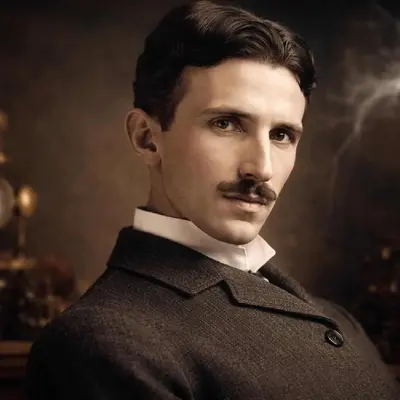
Who Was Nikola Tesla?
Serbian-American engineer and physicist Nikola Tesla made dozens of breakthroughs in the production, transmission, and application of electric power. He invented the first alternating current (AC) motor and developed AC generation and transmission technology.
During his lifetime, Nikola was granted over 700 patents. He completely changed the way the world harnessed electricity. He also invented the Tesla Coil.
Furthermore, though he was famous and respected, he was never able to translate his copious inventions into long-term financial success — unlike his early employer and chief rival, Thomas Edison.
Tesla was, in every sense, the ultimate visionary. He gave the modern world its power. Yet the modern world did not give him his due — not until long after his death.
Early Life: A Village, a Mother’s Genius, and a Mind Like No Other
Birth in Smiljan, Croatia
Tesla was born on July 10, 1856, in the Austrian Empire town of Smiljan, now part of Croatia. He was one of five children, including siblings Dane, Angelina, Milka, and Marica.
His father, Milutin Tesla, was an Orthodox priest and a writer. His mother, Georgina Đuka Tesla, was an inventor of household appliances.
Nikola’s interest in electrical invention was spurred by his mother, Djuka Mandic, who invented small household appliances in her spare time while her son was growing up. Therefore, the greatest inventor of the modern age inherited his genius from a woman who could neither read nor write — but whose hands could build anything.
A Tragic Childhood and an Early Gift for Numbers
In 1863, Tesla’s brother Daniel was killed in a riding accident. The event shook the family deeply. However, young Nikola continued to grow intellectually at a remarkable pace.
Tesla’s early education began in Karlovac, where he attended the Higher Real Gymnasium. He excelled in mathematics and physics, demonstrating an extraordinary ability to visualize complex mathematical equations and solve problems without any written work.
His lifelong passion for energy and electricity was evident even as a child when he created his own tiny waterwheels and turbines. These were not toys. They were the first sketches of a revolution.
Education Across Europe
Tesla received quite a bit of education. He studied at the Realschule in Karlstadt, Germany; the Polytechnic Institute in Graz, Austria; and the University of Prague during the 1870s.
At Graz, Tesla first envisioned challenging the conventional dynamo motor with alternating current. His professor dismissed the notion. But Tesla had already glimpsed the outline of a revolution.
He left Graz to work briefly as a draftsman in Maribor, Slovenia. Years later, the records would confirm what his departure had already made clear — he had never graduated.
The Spark of Genius: Budapest, 1882
Tesla found work as an electrician at the Budapest Telephone Exchange. In Budapest, while walking through a park in 1882, he first envisioned the rotating magnetic field that would become the basis for his AC induction motor.
It happened in a single flash of insight. He was reciting poetry when the idea struck him. He dropped to one knee. He drew the motor’s design in the dirt with a stick. The world would never be the same.
Arriving in America: Four Cents and a Letter to Edison
In 1884, Tesla arrived in New York with four cents in his pocket and a letter of introduction to Thomas Edison.
With little more than a few cents, some poems and sketches, and a mind filled with ideas, he boarded the SS City of Richmond for New York.
He worked briefly for Thomas Edison. However, their opposing goals and temperaments soon made collaboration impossible.
Tesla struck out on his own. In the years that followed, he created the alternating current induction motor and developed a polyphase distribution system that would transform the world.
After an unsuccessful attempt to start his own Tesla Electric Light Company and a stint digging ditches for $2 a day, Tesla found backers to support his research into alternating current.
The War of Currents: Tesla vs. Edison
Two Visions, One World
One of the most dramatic chapters in the Nikola Tesla story is the famous “War of Currents” — a fierce competition between direct current (DC) and alternating current (AC). While Edison strongly supported DC power, Tesla championed AC as a more efficient and practical system for transmitting electricity over long distances.
Westinghouse Steps In
In 1888, George Westinghouse recognized the value of Tesla’s inventions, purchased his patents, and brought him on as a consultant. Together they championed AC power against Edison’s direct current in the War of Currents.
Edison’s Smear Campaign
Edison launched a campaign to discredit AC technology. He even went so far as to demonstrate its dangers by publicly electrocuting animals. It was a desperate act. It was also a losing one.
The 1893 World’s Fair: Victory for AC
Westinghouse used Tesla’s alternating current system to light the World’s Columbian Exposition at Chicago in 1893. This success was a factor in their winning the contract to install the first power machinery at Niagara Falls, which bore Tesla’s name and patent numbers. The project carried power to Buffalo by 1896.
AC had won. Tesla’s victory in the War of Currents led to the widespread adoption of AC power, which remains the global standard today.
Greatest Inventions: A Mind That Saw Tomorrow
The AC Induction Motor
Tesla’s most important invention is considered to be the discovery of rotating magnetic currents that led to AC use in his coil and motor. His motor was durable, cheaper, and more efficient than any rival design. It powered the Second Industrial Revolution.
The Tesla Coil (1891)
A Tesla coil is an invention made by Nikola Tesla in 1891. A resonant electrical transformer circuit was used to generate alternating current energy with a high voltage, low current, and high frequency. Today, it still forms the basis of radio technology and wireless transmission.
Radio Communication
Tesla’s work in signaling and communication used radio waves — electromagnetic waves with a frequency of 30 hertz to 300 gigahertz.
Later that year — the same year Tesla died — the US Supreme Court voided four of Marconi’s key patents, belatedly acknowledging Tesla’s innovations in radio. Justice arrived. However, it came too late.
The Remote-Controlled Boat (1898)
In 1898, Tesla announced his invention of a teleautomatic boat guided by remote control. When skepticism was voiced, Tesla proved his claims before a crowd in Madison Square Garden. The world’s first remote-controlled vehicle. Demonstrated in public. Almost 130 years ago.
Colorado Springs and Terrestrial Stationary Waves (1899)
In Colorado Springs, Colorado, where he stayed from May 1899 until early 1900, Tesla made what he regarded as his most important discovery — terrestrial stationary waves. By this discovery, he proved that Earth could be used as a conductor and made to resonate at a certain electrical frequency.
Tesla proposed a world system of wireless communications to relay telephone messages across the ocean, to broadcast news, stock market reports, private and military messages, and even pictures and music to any part of the world.
He described the internet. In 1900. He simply called it his “World System.”
Wardenclyffe Tower: The Dream That Was Destroyed
Tesla designed the Wardenclyffe Tower on Long Island, New York, as part of his dream to create a global wireless communication and power transmission system. The project was never completed due to financial difficulties.
He secured backing from financier J.P. Morgan and began building a global communications network centered on a giant tower at Wardenclyffe, on Long Island. But funds ran out, and Morgan balked at Tesla’s grandiose schemes.
The tower was torn down in 1917 to pay debts. It remains one of history’s greatest unfinished masterpieces.
Personal Life: Eccentricities, Obsessions, and Pigeons
A Mind With Its Own Rules
Tesla was brilliant. He was also deeply unusual. He was quite impractical in financial matters and an eccentric, driven by compulsions and a progressive germ phobia.
His obsession with the number three and fastidious washing were dismissed as the eccentricities of genius. He would walk around a building three times before entering. He demanded 18 napkins at dinner. He refused to touch anything that was not divisible by three.
His Love of Pigeons
He spent his final years feeding — and, he claimed, communicating with — the city’s pigeons.
His particular relationship was with a female pigeon with whom he communicated in unusual ways. He said of her: “This pigeon was the joy of my life. I loved her as a man loves a woman. If she needed me, nothing else mattered. As long as I had her, I had my life goal.”
When the pigeon died, he said a light had gone out of his life.
Famous Friends
Tesla allowed himself only a few close friends. Among them were the writers Robert Underwood Johnson, Mark Twain, and Francis Marion Crawford.
He was also known for his elegance. He had a sense for style, and several times won the title of the best-dressed man on Fifth Avenue in New York.
Never Married
Tesla never married. He never had children. He devoted his entire life to science. He once said that his chastity was essential to his creative powers — a sacrifice he made willingly and without regret.
Final Years and Death
Tesla’s final years were spent in poverty. He lived alone in cheap hotels. He continued working on new ideas, though his health was fading.
Tesla died in his room on January 7, 1943. He was 86 years old. He died alone. He died in debt. He died largely forgotten by the world he had powered.
However, justice followed. Later that year, the US Supreme Court voided four of Marconi’s key patents, belatedly acknowledging Tesla’s innovations in radio. The AC system he championed and improved remains the global standard for power transmission.
His resting place is the Nikola Tesla Museum in Belgrade, Serbia.
Awards and Recognition
Tesla received numerous prestigious awards throughout his life, including the Order of St. Sava (1892), the Elliott Cresson Medal (1894), the Order of Prince Danilo I (1895), the AIEE Edison Medal (1916), the Order of the Yugoslav Crown (1931), the John Scott Medal (1934), the Order of the White Eagle (1937), and the Order of the White Lion (1937).
Additionally, the unit of magnetic flux density was named the “tesla” in his honor — a scientific immortality that no award could surpass.
Tesla’s Enduring Legacy
The AC system he championed and improved remains the global standard for power transmission.
His name lives on in the electric car company Tesla, Inc. His theories underpinned radio, wireless charging, fluorescent lighting, X-rays, radar, and the modern electrical grid.
Today, Tesla’s legacy lives on in everything from power grids to wireless devices, proving that his visionary ideas were far ahead of their time — ensuring that his story continues to fascinate new generations.
As Tesla himself said: “The present is theirs; the future, for which I really worked, is mine.”
He was right.
Timeline of Key Events
| Year | Milestone |
|---|---|
| 1856 | Born in Smiljan, Croatia |
| 1863 | Brother Daniel killed in riding accident |
| 1875–1878 | Studies at Graz University of Technology |
| 1882 | Envisions the rotating magnetic field in Budapest |
| 1884 | Arrives in New York; works with Thomas Edison |
| 1887–1888 | Develops AC induction motor; patents purchased by Westinghouse |
| 1891 | Invents the Tesla Coil; becomes a U.S. citizen |
| 1893 | AC lights the Chicago World’s Fair; wins over public |
| 1895 | New York laboratory destroyed by fire |
| 1896 | Niagara Falls power plant begins delivering AC power to Buffalo |
| 1898 | Demonstrates first remote-controlled boat at Madison Square Garden |
| 1899–1900 | Colorado Springs experiments; discovers terrestrial stationary waves |
| 1901–1917 | Builds (and loses) Wardenclyffe Tower on Long Island |
| 1943 | Dies alone in New York; US Supreme Court restores radio patents to Tesla |