Leonardo da Vinci
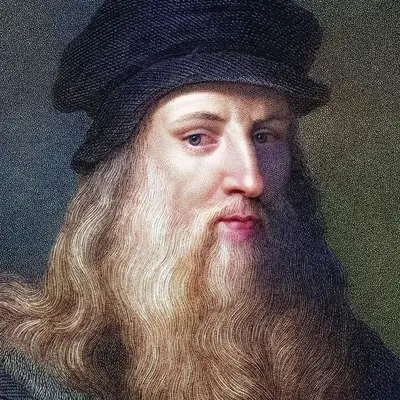
Who Was Leonardo da Vinci?
Leonardo di ser Piero da Vinci was an Italian polymath of the High Renaissance, active as a painter, draughtsman, engineer, scientist, theorist, sculptor, and architect. He lived from April 15, 1452, to May 2, 1519.
While his fame initially rested on his achievements as a painter, he also became known for his notebooks, in which he made drawings and notes on a variety of subjects including anatomy, astronomy, botany, cartography, painting, and paleontology.
Leonardo is widely regarded as a genius who epitomized the Renaissance humanist ideal. His collective works comprise a contribution to later generations of artists matched only by that of his younger contemporary, Michelangelo.
He was not simply a great painter. He was a great human being. He saw the world differently — and changed how the rest of us see it too.
Early Life: Born Illegitimate, Destined for Greatness
A Humble Beginning in Vinci, Tuscany
Leonardo was born on April 15, 1452, in Vinci, a small town in the Republic of Florence. He was the illegitimate son of a notary, Ser Piero, and a peasant woman, Caterina. He grew up between town and countryside.
This mattered more than it might seem. Surrounded by hills, streams, plants, and animals, young Leonardo developed a habit of careful observation that would shape his entire life.
Therefore, from the very beginning, nature was his first classroom. It remained his greatest teacher throughout his entire life.
Leonardo lived with his mother until he was five and then moved in with his father and stepmother. Despite being born out of wedlock, his father recognized his remarkable abilities early on. That recognition would change the course of history.
Childhood Curiosity: The First Signs of Genius
His early life in rural Italy allowed him to closely observe nature, which later influenced his paintings and scientific studies.
He watched water flow. He studied how birds moved their wings. He sketched plants and animals with extraordinary precision. These were not the hobbies of a child. They were the early sparks of a revolutionary mind.
Training and Education: The Workshop of Andrea del Verrocchio
Apprenticeship at Age 14
At 14, Leonardo became an apprentice to Andrea del Verrocchio, a famous painter and sculptor in Florence. Under Verrocchio’s guidance, Leonardo learned painting, sculpting, and mechanical arts. He also studied anatomy, mathematics, and engineering, which later influenced his work.
In Verrocchio’s renowned workshop, Leonardo received a multifaceted training that included painting and sculpture as well as the technical-mechanical arts.
Additionally, Florentine tax records and guild documents trace his collaborations with fellow apprentices such as Botticelli and Ghirlandaio, as well as commissions for civic pageants and mechanical devices.
A Master by Age 20
Hard work and raw talent brought swift recognition. By the age of 20, Leonardo was already a master painter in the Guild of Saint Luke, marking the beginning of an extraordinary career.
Completing his apprenticeship in 1472, Leonardo became a paid assistant to Verrocchio and was registered as a master in the painter’s guild of Florence.
His talent was already undeniable. However, Florence was only the beginning.
Career: From Florence to Milan to France
Florence: The Foundations (1472–1482)
Leonardo began his independent career in Florence. From these early years, he began filling notebooks with notes on water, light, and physiognomy, nurtured by Verrocchio’s library and the humanist manuscripts circulating in Florence.
During this period, he produced several early works. These include The Annunciation (c. 1472) and the unfinished Adoration of the Magi. Each work revealed a mind already pushing far beyond his contemporaries.
Milan Under Ludovico Sforza (1482–1499)
In 1482, Leonardo made a pivotal move. He left Florence for Milan, offering Ludovico Sforza his services as military engineer, architect, and painter. He staged court pageants, designed theatrical machines, planned canals, and drafted treatises on painting and hydrodynamics.
His pictorial output reached a peak with The Last Supper (1495–1498) for Santa Maria delle Grazie, where he experimented with a mixed oil-tempera technique to achieve unprecedented light and psychological depth.
Milan was a turning point. It was here that Leonardo produced some of his greatest works and deepest scientific investigations.
Return to Florence and the Mona Lisa (1500–1508)
Around 1503–1506, back in Florence, he worked on the Mona Lisa and large-scale projects like the Battle of Anghiari mural.
The Mona Lisa became the most famous painting ever created. The fact that he kept the painting until his death is why it now hangs in the Louvre in Paris and not in Italy.
French law now classifies it as a national treasure that cannot leave the Louvre Museum. The painting’s fragility and extreme value — with insurance estimates exceeding $800 million — make loans practically impossible.
Milan Again, Then Rome (1508–1516)
Da Vinci returned to Milan in 1508, where he spent the following five years under the sponsorship of the French Governor of Milan, Charles d’Amboise, and King Louis XII. During this time, he was highly involved in scientific pursuits such as anatomical, mathematical, mechanical, and botanical research, as well as the development of his renowned flying machine.
From 1513 to 1516, he resided in Rome under papal patronage, continuing his anatomical, engineering, and scientific studies.
France: The Final Chapter (1516–1519)
In 1516, Leonardo moved to France at the invitation of King Francis I and settled at Clos Lucé near Amboise.
His connections with the French monarchy served him well. The aged genius accepted an invitation from the French king to live in France as a guest of the crown.
It was a peaceful and honored end to a restless, brilliant life. During his lifetime, Leonardo da Vinci had attained fame as a painter, sculptor, architect, and engineer.
He died on May 2, 1519, at Clos Lucé, Amboise, France, aged 67. He was laid to rest at Château d’Amboise.
Masterworks: Paintings That Defined an Era
The Mona Lisa (c. 1503–1516)
The Mona Lisa is the most recognized painting in the world. The painting’s insurance estimates exceed $800 million, making loans practically impossible.
Leonardo invented a revolutionary technique for it. He used sfumato — soft, smoky blending of tones — that created depth and psychological mystery no painter had achieved before. The subject’s faint smile has fascinated viewers for over five centuries. It continues to do so today.
The Last Supper (c. 1495–1498)
The Last Supper is a fresco that captures the moment Jesus reveals that one of his disciples will betray him. This composition is renowned for its innovative perspective and the intricate emotions displayed on the faces of the apostles.
It can be found at Santa Maria delle Grazie in Milan. It remains one of the most studied religious artworks in all of history.
The Vitruvian Man (c. 1490)
The Vitruvian Man is not just pretty geometry. It is proportional study in action, mapping the mathematical relationships within the human body. Standing inside a perfect circle and square, the figure shows Leonardo testing Vitruvian proportions against actual human measurements.
In their desire to relate the human body to the wider workings of the cosmos, humanists like Leonardo seized on the architectural theories of the first-century B.C. Roman writer Vitruvius. His treatise, rediscovered in the early 1400s, established proportional rules for the human body.
Other Notable Works
His notable works also include Virgin of the Rocks (c. 1483–1493) and Lady with an Ermine (c. 1489–1491). Additionally, The Annunciation (c. 1472) and the unfinished Adoration of the Magi are celebrated as extraordinary examples of his early artistry.
Scientific Discoveries: Centuries Ahead of His Time
Anatomy: Rewriting the Human Body
Da Vinci meticulously dissected human cadavers, producing detailed anatomical drawings that revolutionized the understanding of human anatomy.
Galen’s incorrect heart anatomy had gone unchallenged for 1,400 years — until Leonardo drew the first accurate depictions. His cross-sectional views of organs introduced entirely new ways to visualize internal structures.
Furthermore, his anatomical interest was sparked during his apprenticeship in Andrea del Verrocchio’s workshop. Over the following two decades, he did practical work in anatomy on the dissection table in Milan, then at hospitals in Florence and Rome.
Engineering and Invention
Machines Leonardo conjured up include cranes, paddlewheel boats, tanks, cannons, apparatus to breathe underwater, and even flying contraptions. The only element many of these designs lacked was an internal combustion engine, not to be invented until centuries later.
The earliest sketches that predicted the helicopter, parachute, and military tank are attributed to him.
He also invented effective military weapons, including an early prototype of the machine gun and a well-known huge crossbow.
Optics, Light, and Shadow
Leonardo filled notebooks with light behavior observations. He understood that light does not just illuminate — it creates form. Shadows fascinated him. Not just their shapes, but their edges. Hard or soft? Sharp or blurry?
This obsession with light gave his paintings their extraordinary depth. It also gave science a new language for understanding vision.
The Notebooks: A Treasure of Human Thought
His notebooks contain thousands of pages filled with sketches, ideas, and scientific observations.
It is primarily through Leonardo’s drawings and notes that we can understand the man and his achievements. He drew incessantly — to devise his artistic projects, to explore the natural world, and to record the workings of his imagination. Leonardo kept thousands of these drawings to the end of his life, leaving them to his favourite pupil Francesco Melzi, to ensure that his legacy would be preserved.
Importantly, his scientific discoveries were not published during his lifetime. Therefore, the world had to wait centuries to truly understand what he had already figured out.
Personal Life: The Private Genius
Leonardo never married. He had no known children. He kept his personal life as private as his notebooks were revealing.
Leonardo was left-handed. He was known to write his notes in mirror script — from right to left — a habit that has fascinated scholars for centuries. Some believe it was done to prevent ink smudging. Others suggest it was a form of personal code.
He worked for the Medici family in Florence, Ludovico Sforza in Milan, Cesare Borgia in the Papal States, Pope Leo X in Rome, and King Francis I in France. His life was one of constant movement — always in search of a patron who could match his ambition.
He was also deeply curious about every living thing. He studied the human body, plants, and animals, leading to detailed anatomical sketches that displayed not only artistic skill but also scientific rigor.
Legacy: Why Leonardo Still Matters Today
After Leonardo da Vinci’s death, his notebooks were studied and recognized as treasures of scientific thought. He inspired generations of artists and scientists. His works are studied in art, science, and engineering courses. The Mona Lisa remains one of the most visited artworks globally.
His indelible mark on history is undeniable. His multifaceted genius transcended conventional boundaries, leaving an enduring legacy that inspires and captivates. From his revolutionary artworks to his pioneering scientific inquiries and inventive designs, da Vinci’s influence reverberates through the centuries.
He pushed realism through light, anatomy, and composition — influencing European painting for centuries. He wasn’t just a painter, but a scientist who understood how light travels through the pupil to the retina.
Leonardo did not simply create beautiful things. He taught the world how to see.
Timeline of Key Events
| Year | Event |
|---|---|
| 1452 | Born in Vinci, Tuscany, Italy |
| c. 1466 | Apprenticed to Andrea del Verrocchio in Florence |
| 1472 | Completes apprenticeship; registered as master painter |
| c. 1472 | Completes The Annunciation |
| 1482 | Moves to Milan; enters service of Ludovico Sforza |
| c. 1483 | Completes Virgin of the Rocks |
| c. 1490 | Completes Lady with an Ermine; draws Vitruvian Man |
| 1495–1498 | Paints The Last Supper in Milan |
| 1500 | Returns to Florence after French invasion of Milan |
| c. 1503–1516 | Works on the Mona Lisa |
| 1508 | Returns to Milan under French patronage |
| 1513 | Moves to Rome under Pope Leo X |
| 1516 | Moves to France; guest of King Francis I at Clos Lucé |
| 1519 | Dies at Amboise, France, aged 67 |
Where to See Leonardo’s Works Today
| Location | What You Can See |
|---|---|
| Louvre Museum, Paris | Mona Lisa, Virgin of the Rocks (first version) |
| Santa Maria delle Grazie, Milan | The Last Supper |
| Uffizi Gallery, Florence | Adoration of the Magi, The Annunciation |
| Vatican Museums, Rome | St. Jerome in the Wilderness (unfinished) |
| National Gallery, London | Virgin of the Rocks (second version) |