Jane Austen
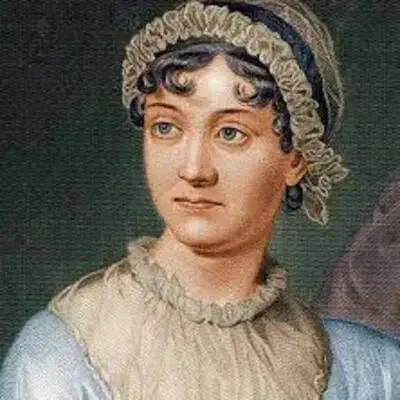
Sagittarius
Who Is Jane Austen?
Jane Austen (December 16, 1775 – July 18, 1817) was an English novelist whose six completed novels have never gone out of print. She wrote about a world she knew intimately — the English landed gentry — and exposed its hypocrisies, its marriage markets, and its quiet cruelties with a precision that no contemporary matched.
Her heroines are sharp, her prose is ironic, and her plots turn on money as much as love. Pride and Prejudice, Sense and Sensibility, Emma, Mansfield Park, Northanger Abbey, and Persuasion together form one of the most studied bodies of work in the English language.
She published during her lifetime under the pseudonym “By a Lady.” She died at 41. Two centuries later, her face appears on the British £10 note.
Early Life: A Rectory, Seven Siblings, and a Father Who Believed in Her
Steventon, Hampshire (1775–1801)
Jane Austen was born on December 16, 1775, in Steventon, a village in Hampshire, England. Her father, the Reverend George Austen, served as rector of the parish church. Her mother, Cassandra Leigh Austen, came from a family with aristocratic connections.
She was the seventh of eight children. Her closest companion throughout her life was her sister Cassandra, two years her senior. The Austen household was intellectually lively. George Austen kept a library of five hundred volumes and encouraged all his children to read widely.
At age seven, Jane was sent with Cassandra to Mrs Cawley’s school in Oxford, then to the Abbey House School in Reading. Both stays were brief. By 1786, she was back home in Steventon. Most of her real education came from her father’s library and from her own habit of writing.
The Juvenilia (1787–1793)
Jane began writing fiction at around age eleven. Between 1787 and 1793, she filled three notebooks — later known as Volume the First, Volume the Second, and Volume the Third — with short stories, plays, and parodies. These juvenile pieces were sharp and satirical from the start. One, “Love and Freindship” (spelled as she wrote it), mocks the conventions of sentimental fiction with comic skill she had not yet learned to restrain.
Her brother Henry later described her as writing with “extraordinary facility.” The juvenilia show a writer who had already identified her target — sentimentality, affectation, and social pretension — before she turned sixteen.
Career Highlights: Six Novels and a Reputation Built Slowly
First Drafts and Early Rejections (1795–1803)
Austen drafted the novel she called “Elinor and Marianne” around 1795. She revised it into Sense and Sensibility and eventually published it in 1811. “First Impressions,” the early draft of Pride and Prejudice, was completed in 1797. Her father submitted it to the London publisher Cadell and Davies that year. They declined without reading it.
In 1803, a manuscript version of Northanger Abbey — then titled “Susan” — was sold to the publisher Richard Crosby for £10. Crosby never published it. Austen’s brother Henry eventually bought it back in 1816 for the same £10.
Bath and Southampton: The Silent Years (1801–1809)
In 1801, George Austen retired and moved the family to Bath. Jane reportedly fainted when told of the decision. The Bath years produced no finished novels. She began and abandoned “The Watsons” around 1804. Her father died in January 1805. The family’s finances became precarious.
After two years in Southampton, Jane, Cassandra, and their mother moved in 1809 to Chawton Cottage in Hampshire, a house provided by her brother Edward. Chawton was the turning point. Within months, Austen was revising old manuscripts and writing new ones.
Publication and Recognition (1811–1817)
Sense and Sensibility appeared in October 1811, published on commission by Thomas Egerton. Austen paid the costs herself. It sold out within twenty months and earned her £140.
Pride and Prejudice followed in January 1813. Egerton paid her £110 outright for the copyright — a decision she later regretted, as the novel sold three editions in three years. She described it privately as “my own darling child.”
Mansfield Park was published by Egerton in May 1814. Emma appeared in December 1815, dedicated to the Prince Regent at his request — a dedication she accepted without enthusiasm. By this point, her identity as the author was an open secret in London literary circles, even as she continued to publish anonymously.
Persuasion and Northanger Abbey were published together in December 1817, four months after her death.
Her final, unfinished novel, Sanditon, was abandoned in March 1817 when her health collapsed. She had completed eleven chapters.
Beyond Fiction: Letters, Legacy, and the Culture She Shaped
The Letters
Austen wrote hundreds of letters during her lifetime. Around 160 survive, the majority addressed to Cassandra. They are candid, funny, and sometimes uncomfortably sharp about neighbours, relatives, and acquaintances. Cassandra destroyed a substantial number after Jane’s death to protect her sister’s privacy. What remains gives a vivid picture of domestic life in Regency England and of a writer with opinions she did not always put into her novels.
Adaptations and Cultural Afterlife
Her work has generated adaptations on stage, screen, and radio for over a century. The 1995 BBC television adaptation of Pride and Prejudice, starring Colin Firth and Jennifer Ehle, introduced Austen to a generation who had not read her. The 1995 film Sense and Sensibility, scripted by Emma Thompson, won the Academy Award for Best Adapted Screenplay. Adaptations of Emma appeared in 1996 (with Gwyneth Paltrow), 2009 (BBC), and 2020.
The Bank of England placed her portrait on the £10 note in July 2017, two hundred years after her death.
Academic Study and the Janeites
Austen scholarship became a discipline in its own right during the twentieth century. The Jane Austen Society was founded in 1940. The Jane Austen Society of North America was established in 1979. Her home at Chawton is now the Chawton House Museum. Academics, fans, and what Henry James called “Janeites” — devoted admirers — have sustained her reputation without interruption since her rediscovery in the 1870s.
Personal Life: Cassandra, Tom Lefroy, and a Proposal Refused
Her Sister and Her Closest Relationship
Jane and Cassandra Austen remained inseparable throughout their lives. When Jane was away from home, she wrote to Cassandra almost daily. Cassandra was her first reader, her most trusted critic, and the person who managed her reputation after her death.
Tom Lefroy and the Question of Romance
In January 1796, Jane wrote to Cassandra about a young Irish law student named Tom Lefroy, describing their dancing and flirting at local balls. The letters are playful. His family separated them — he had no money, and neither did she. Lefroy later became Lord Chief Justice of Ireland. In old age, he reportedly admitted he had been in love with her.
In December 1802, Harris Bigg-Wither, heir to a substantial Hampshire estate, proposed to Jane. She accepted. The following morning, she withdrew her acceptance. Her reasons are not recorded. She never married.
Final Illness and Death
By early 1816, Austen’s health was declining. She suffered from fatigue, back pain, and a discolouration of the skin. Modern medical analysis has suggested Addison’s disease or Hodgkin lymphoma, though no diagnosis was made at the time. On July 18, 1817, she died in Winchester at the age of 41. She is buried in Winchester Cathedral.
Published Works
| Title | Drafted | Published | Publisher | Notes |
|---|---|---|---|---|
| Sense and Sensibility | c. 1795 | October 1811 | Thomas Egerton | Published at Austen’s own expense |
| Pride and Prejudice | 1796–1797 | January 1813 | Thomas Egerton | First titled “First Impressions” |
| Mansfield Park | 1811–1813 | May 1814 | Thomas Egerton | — |
| Emma | 1814–1815 | December 1815 | John Murray | Dedicated to the Prince Regent |
| Northanger Abbey | c. 1798–1803 | December 1817 | John Murray | Published posthumously |
| Persuasion | 1815–1816 | December 1817 | John Murray | Published posthumously |
| Sanditon | January–March 1817 | 1925 (fragment) | — | Unfinished; eleven chapters completed |