Isaac Newton
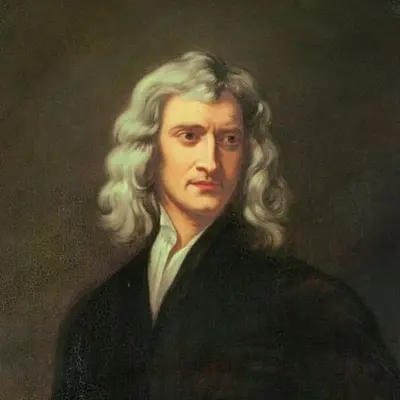
Who Was Sir Isaac Newton?
Sir Isaac Newton was an English natural philosopher whose Philosophiae Naturalis Principia Mathematica (1687) established universal gravitation and the three laws of motion. His Opticks (1704) reshaped the science of light and colour. His calculus, theology, alchemy, and Mint administration filled a working life of unusual breadth.
Newton is widely regarded as one of the most influential scientists of all time. His discoveries laid the foundation of classical mechanics and changed the way humanity understands motion, gravity, and light.
From a fatherless boy in rural Lincolnshire to the godfather of modern science — Newton’s journey remains one of the most extraordinary in human history.
Early Life: A Fatherless Boy in Woolsthorpe
Birth and Family Hardship
On Christmas Day, 1642, as England stood on the edge of civil war, a frail and fatherless boy was born in the rural hamlet of Woolsthorpe-by-Colsterworth in Lincolnshire. He arrived so prematurely and weak that few believed he would live through the night. The midwives believed him too small, barely the size of a quart mug. But against every odd, the child drew breath and lived. His name was Isaac Newton.
His father — a prosperous but uneducated farmer also named Isaac — had died just months before his birth. His mother, Hannah Ayscough Newton, was a strict Puritan widow. When Isaac was only three, she left him in the care of his grandparents to remarry and begin a new family — a wound that carved a deep scar into Newton’s soul.
Therefore, from his very first breath, Newton faced a world that seemed determined to underestimate him.
Childhood and Early Schooling
As a young child, Newton went to local elementary schools. When he was 12, Newton was enrolled at the King’s School in Grantham, about 7 miles away from Woolsthorpe.
Despite initial academic struggles, Newton quickly rose to the top of his class. He even stood up to bullies who attempted to harass him. After four years at the grammar school, Newton’s mother brought him back to Woolsthorpe, intending to prepare him for a farming life.
However, farming was never his destiny. He preferred reading to working. It became apparent that farming was not his calling.
Hannah’s brother — who had received an M.A. from Cambridge — and the headmaster of the Grantham school persuaded his mother that Isaac should prepare for the university. After further schooling at Grantham, he entered Trinity College in 1661, somewhat older than most of his classmates.
Education: Trinity College, Cambridge
In 1661, Newton started as an undergraduate at Trinity College in Cambridge. Even though his mother had the means to support him in college, she only gave him a small allowance.
He came to Cambridge as a poor student, working as a servant to pay his way. At first, he was largely unnoticed — quiet and unremarkable. But he devoured books — Aristotle, Descartes, Galileo, and Kepler.
At Cambridge, however, Newton found the curriculum centered around Aristotelian philosophy. He found it inadequate to explain the natural world. During this time, he encountered the works of philosophers such as René Descartes and astronomers like Galileo Galilei, which inspired his independent thinking.
Newton became a professor of mathematics at age twenty-seven and stayed at Trinity in that capacity for twenty-seven years. Furthermore, he was Lucasian Professor of Mathematics at Cambridge from 1669 to 1702.
The Annus Mirabilis: Newton’s Year of Miracles (1665–1667)
This is where the legend truly begins.
In 1665, the Great Plague swept through London, forcing Cambridge to close. Newton returned home to Woolsthorpe, and there — in the quiet of the countryside, away from the distractions of academia — he underwent what he later called his annus mirabilis: his year of miracles. In those two years of isolation, Newton laid the foundation for three of the greatest pillars of modern science: calculus, optics, and the laws of motion and gravity.
During this period, he made his initial experimental discoveries in optics and developed the mathematical theory of uniform circular motion. He also noted the relationship between the inverse-square law and Kepler’s rule relating the square of the planetary periods to the cube of their mean distance from the Sun.
The Famous Apple
The story of the falling apple has become myth, but it is not fiction. Newton himself recounted that he had been sitting in the orchard when he saw an apple fall. What intrigued him was not simply that it fell — but why it fell straight down and not sideways or upward. Was the force that pulled the apple to the ground the same force that held the moon in orbit? From that simple question, the theory of universal gravitation was born.
Scientific Discoveries: Rewriting the Rules of the Universe
The Laws of Motion
Book I of the Principia sets out the three laws of motion: a body remains at rest or in uniform motion unless acted on by a force; force equals mass times acceleration; for every action there is an equal and opposite reaction.
These three laws were revolutionary. Before Newton, no one had expressed the rules of physical motion so clearly. Additionally, no one had shown they applied equally to every object — from a falling apple to a distant planet.
The Law of Universal Gravitation
Most profound of all was his Law of Universal Gravitation. He showed that every particle of matter in the universe attracts every other particle with a force proportional to their masses and inversely proportional to the square of the distance between them. The same force that caused the apple to fall also governed the movement of the planets and moons.
The Principia did not just explain the heavens — it united them with Earth. It was as though a veil had been lifted, revealing a universe that was not capricious or unknowable, but orderly, governed by laws that could be discovered and written in the language of mathematics.
Calculus: A New Language of Mathematics
Newton had the essence of the methods of fluxions — his form of calculus — by 1666.
In Paris in 1675, Gottfried Wilhelm Leibniz independently evolved the first ideas of his differential calculus, outlined to Newton in 1677. Newton had already described some of his mathematical discoveries to Leibniz, not including his method of fluxions. In 1684, Leibniz published his first paper on calculus; a small group of mathematicians took up his ideas.
Therefore, the question of who invented calculus first became one of history’s most bitter scientific disputes. Today, both Newton and Leibniz are credited as independent co-inventors.
Optics: Unlocking the Rainbow
In 1672, Newton turned his attention to light and optics, publishing his first paper with the Royal Society. In it, he boldly claimed that white light was not pure — as previously believed — but composed of a spectrum of colours.
Using a simple prism, he split sunlight into a rainbow and then recombined it. It was an elegant experiment, easy to replicate and impossible to ignore.
Newton discovered measurable, mathematical patterns in the phenomenon of colour — a breakthrough that transformed the science of optics forever.
The Reflecting Telescope
In 1668, Isaac Newton designed and built a reflective telescope — the first of its kind — for the Royal Society in England.
He ground the mirror, built the tube, and even made his own tools for the job. This instrument produced sharper images than any lens-based telescope before it. It was a practical triumph that matched his theoretical brilliance.
The Principia Mathematica (1687): The Greatest Scientific Book Ever Written
Isaac Newton is best known for his theory about the law of gravity, but his Principia Mathematica (1687) — with its three laws of motion — greatly influenced the Enlightenment in Europe.
In 1684, English astronomer Edmund Halley paid a visit to the secluded Newton. Upon learning that Newton had mathematically worked out the elliptical paths of celestial bodies, Halley urged him to organize his notes. The result was the 1687 publication of Philosophiae Naturalis Principia Mathematica.
The Principia is the founding work of modern physics and one of the most influential scientific books ever written. The philosophical implications it forced on later thinkers — about space, time, causation, and the relation between mathematics and the natural world — are still being worked out.
Public Life: Parliament, the Royal Mint, and the Royal Society
Newton was not only a scientist. He was also a man of considerable public influence.
Newton was Warden and then Master of the Royal Mint from 1696 until his death. He was President of the Royal Society from 1703 until his death. He was also a Member of Parliament for Cambridge University in 1689–1690 and 1701–1702.
At the Royal Mint, Newton ruthlessly pursued counterfeiters, going so far as ensuring the execution of known offenders.
Newton was elected President of the Royal Society in 1703 and knighted by Queen Anne in 1705. He was no longer just a scholar. He was one of the most powerful scientific figures in all of England.
Personal Life: Solitude, Rivalries, and Faith
A Man of Few Relationships
Newton never married. He lived modestly but was buried with great pomp in Westminster Abbey.
Newton was modest, diffident, and a man of simple tastes. He was angered by criticism or opposition and harboured resentment. He was harsh towards enemies but generous to friends.
The Newton–Hooke Rivalry
His ideas were attacked by the prominent physicist Robert Hooke, who argued against Newton’s conclusions on light. Newton, already sensitive and proud, did not handle the criticism well. He withdrew again from public debate.
The death of Hooke in 1703 allowed Newton to take over as president of the Royal Society and publish his work freely.
Faith and Theology
Newton also wrote on Judaeo-Christian prophecy, whose decipherment was essential, he thought, to understanding God. His book on the subject represented a lifelong study.
Although a critic of accepted Trinitarian dogmas and the Council of Nicaea, he possessed a deep religious sense, venerated the Bible, and accepted its account of creation.
Death and Legacy: A State Funeral Fit for a King
Sir Isaac Newton died of kidney failure on March 20, 1727. He was 84 years old. He had never married and left no children. Newton was given a state funeral and buried in Westminster Abbey.
Alexander Pope provided the memorable epitaph: “Nature and Nature’s Laws lay hid by Night: GOD said, Let Newton be! And all was Light.”
His legacy is beyond measure. His Principia established classical mechanics and dominated the field of physics until Einstein’s theory of relativity took its place in the early 20th century.
Furthermore, Newton’s discoveries continue to influence education, research, and technology even today. Studying his biography inspires people to think scientifically and pursue knowledge with discipline and determination.
Major Discoveries at a Glance
| Discovery | Year | Significance |
|---|---|---|
| Calculus (Method of Fluxions) | 1666 | New language of mathematics |
| Optics — White Light Spectrum | 1666–1672 | Proved white light is composite colour |
| Reflecting Telescope | 1668 | First working reflecting telescope |
| Laws of Motion | 1687 | Foundation of classical mechanics |
| Law of Universal Gravitation | 1687 | Unified earthly and celestial motion |
| Opticks Published | 1704 | Formal treatise on light and colour |