Freddie Mercury
Virgo
Who Was Freddie Mercury?
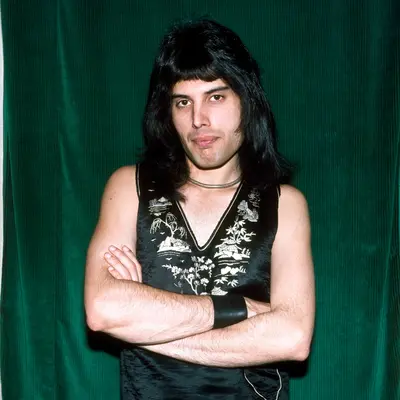
Freddie Mercury (born Farrokh Bulsara; September 5, 1946 – November 24, 1991) was a British singer and songwriter who achieved global fame as the lead vocalist and pianist of the rock band Queen.
Known for his powerful vocal range and theatrical stage presence, Mercury made a significant impact on the music scene during the 1970s and 1980s. Furthermore, he is remembered as one of the most iconic figures in rock music, with songs like “Bohemian Rhapsody,” “Somebody to Love,” and “We Are the Champions” that continue to resonate with audiences to this day.
Freddie Mercury died on November 24, 1991, at the age of 45. However, his music, his legacy, and his spirit remain very much alive.
Early Life: From Zanzibar to the World Stage
Birth and Family Background
The life of Frederick Bulsara began on the East African island of Zanzibar on September 5, 1946. His father, Bomi Bulsara, worked as a cashier for the British Colonial Office, and the family lived in a relatively affluent area.
Mercury’s parents, Bomi and Jer Bulsara, were Parsees — followers of the Zoroastrian religion whose ancestors came from Persia. Therefore, from the very beginning, Freddie’s life was shaped by a rich mix of cultures, faiths, and geographies.
Boarding School in India: Where “Freddie” Was Born
At the age of eight, he was sent from Zanzibar to St. Peter’s School — a British-style boarding school in Panchgani, near Bombay, India. It was there that everything began.
It was at boarding school that his schoolmates began calling him “Freddie” — a name that would stay with him for the rest of his life.
Mercury attended St. Peter’s Church of England School, where he developed his love for music and art. He took piano lessons and later played the instrument in rock bands formed with friends. Moreover, in 1958, Freddie and four friends at St. Peter’s formed the school’s rock and roll band, the Hectics, where Freddie was the piano player. They played at school parties, annual fetes, and school dances.
The Four Extra Teeth and a Voice for the Ages
One of the most fascinating facts about Freddie Mercury involves his teeth. Mercury was born with four extra teeth in the back of his mouth, causing his now-famous bucktooth appearance. His nickname growing up was “Bucky.” Mercury never got his teeth fixed because he was afraid it would ruin his impressive four-octave vocal range.
That decision preserved one of the greatest voices in musical history.
Fleeing Zanzibar: A Family in Exile
In 1964, Mercury’s family fled to England to escape the political unrest in Zanzibar. The Bulsara family was among those who left Zanzibar during the violence. They moved to Feltham, England.
Initially, they lived with relatives in Feltham, Middlesex, until they were able to find their own small terraced house in the area. Freddie was seventeen and had decided he wanted to go to art college.
Ealing College of Art and British Citizenship
Mercury then attended the Ealing College of Art, where he studied graphic art and design and became enmeshed in the London music scene. Mercury became a registered citizen of the United Kingdom on June 2, 1969, the same year he graduated from Ealing Art School.
Additionally, Mercury befriended several musicians during his time at Ealing. These friendships would soon change the course of rock history.
The Formation of Queen: A Rock Dynasty Is Born
Early Bands and Musical Experiments
Before Queen, Freddie tested himself in smaller groups. In 1969, Mercury joined a group called Ibex as their lead singer. He played with a few other bands before joining forces with his future Queen bandmates.
Mercury met his future bandmates, drummer Roger Taylor and guitarist Brian May, around the time he moved to London in the 1960s. They met up with bassist John Deacon in 1971. The quartet played their first gig together that June.
Renaming the Band — and Himself
The birth of Queen was also the birth of Freddie Mercury. Freddie decided to change the name of the band to Queen. He also changed his last name to Mercury.
Freddie designed the band’s logo using their birth signs — two fairies for him (Virgo), two lions for Roger and John (Leo), and a crab for Brian (Cancer). Even the band’s visual identity bore his creative fingerprint.
Career Highlights: The Making of a Rock Legend
A Night at the Opera and “Bohemian Rhapsody” (1975)
The release of the groundbreaking album A Night at the Opera in 1975 marked a watershed moment, featuring the legendary track “Bohemian Rhapsody,” which challenged conventional song structure and became an anthem of the era.
The Library of Congress later added “Bohemian Rhapsody” to the National Recording Registry — a list of audio recordings deemed “culturally, historically, or aesthetically significant.”
The song was unlike anything the world had heard before. It blended rock, opera, and ballad seamlessly. Furthermore, it ran for nearly six minutes at a time when radio stations rarely played anything beyond three. Nevertheless, it reached number one in the UK and became one of the best-selling singles of all time.
Chart-Topping Decade: 1977–1985
Throughout the late 1970s and 1980s, Queen produced a string of chart-topping albums such as News of the World and The Game, featuring hits like “We Are the Champions” and “Another One Bites the Dust.”
Freddie Mercury’s best-known songs include “Bohemian Rhapsody,” “Killer Queen,” “Somebody to Love,” “We Are the Champions,” “We Will Rock You,” “Crazy Little Thing Called Love,” and “Another One Bites the Dust.”
Live Aid 1985: The Greatest Rock Performance in History
Live Aid was a benefit concert held on July 13, 1985, to raise money for famine relief in Africa.
Some 70,000 fans — including Prince Charles and Princess Diana — packed into Wembley Stadium, while an estimated 1.5 billion people watched the television broadcast.
Queen painstakingly rehearsed their set over three full days at London’s Shaw Theatre, opting for a medley — the high moments of six of the band’s hits: “Bohemian Rhapsody,” “Radio Ga Ga,” “Hammer To Fall,” “Crazy Little Thing Called Love,” “We Will Rock You,” and the grand finale, “We Are the Champions.”
His performances leading Queen at Live Aid in 1985 are considered to be among the top live rock performances of all time. It is widely agreed to be the greatest concert performance in history.
Queen’s Complete Studio Discography
| Year | Album Title | Notable Songs |
|---|---|---|
| 1973 | Queen | Keep Yourself Alive |
| 1974 | Queen II | Seven Seas of Rhye |
| 1974 | Sheer Heart Attack | Killer Queen |
| 1975 | A Night at the Opera | Bohemian Rhapsody, Love of My Life |
| 1976 | A Day at the Races | Somebody to Love |
| 1977 | News of the World | We Are the Champions, We Will Rock You |
| 1978 | Jazz | Bicycle Race, Don’t Stop Me Now |
| 1980 | The Game | Another One Bites the Dust, Crazy Little Thing Called Love |
| 1980 | Flash Gordon (OST) | Flash |
| 1982 | Hot Space | Under Pressure (with David Bowie) |
| 1984 | The Works | Radio Ga Ga, I Want to Break Free |
| 1986 | A Kind of Magic | One Vision, A Kind of Magic |
| 1989 | The Miracle | Breakthru, Face It Alone (released 2022) |
| 1991 | Innuendo | Innuendo, The Show Must Go On |
| 1995 | Made in Heaven | Heaven for Everyone (posthumous) |
Solo Career: Beyond Queen
Freddie Mercury did not limit his artistry to Queen alone. He also led a solo career and was a producer and guest musician for other artists.
He continued his artistic exploration away from Queen, working with Giorgio Moroder on the 1979 single “Love Kills” and further delving into synth-based pop on his only proper solo album, 1985’s Mr. Bad Guy. He also paired with opera diva Montserrat Caballé for their 1988 orchestral album Barcelona.
The Barcelona collaboration, in particular, showcased the true breadth of his vocal talent. He was not merely a rock singer. He was a complete vocal artist.
Personal Life: Love, Friendship, and Private Struggles
Mary Austin: The Love of His Life
In 1970, Freddie met Mary Austin. They lived together for seven years and remained good friends until his death.
Mary Austin first met Freddie Mercury in 1970, and it marked the beginning of an enduring friendship that would shape the rest of each of their lives.
When Freddie passed away in 1991, he left to his former fiancée and dearest friend Mary Austin not only his house and possessions but also a creative archive spanning almost two decades.
He famously dedicated “Love of My Life” from A Night at the Opera to her. She remained his closest confidant until his final breath.
Jim Hutton: His Final Partner
Mercury’s partners included Mary Austin (1970–1976) and Jim Hutton (1985–1991). Jim Hutton was by Freddie’s side during his final years. He was a steady presence of love and care during the most difficult chapter of Mercury’s life.
Sexuality and Privacy
Freddie Mercury stayed silent about AIDS and his own sexual orientation until just before his death. His intention was to protect those close to him in an era in which AIDS carried a heavy social stigma for its victims and their inner circle.
Despite this, Freddie Mercury is now celebrated globally as one of the most iconic LGBTQ+ figures in music history.
Final Years, Illness, and Death
The AIDS Diagnosis
Mercury was diagnosed with AIDS in 1987. He continued to record with Queen.
He publicly announced that he had AIDS the day before he died of complications related to the disease.
His announcement was brief. It was dignified. It was entirely on his own terms.
Death on November 24, 1991
Mercury died of AIDS-related bronchial pneumonia on November 24, 1991, at age 45. He passed away at his home in Kensington, London. The world mourned as one.
His final Queen album, Innuendo, was released earlier in 1991. It reached number one in the UK. Songs like “The Show Must Go On” now feel like a deeply personal farewell — a man refusing to stop until his last breath.
Legacy: A Voice That Will Never Be Forgotten
Bohemian Rhapsody — The 2018 Film
In 2018, Queen was the subject of the biopic Bohemian Rhapsody, which starred Rami Malek as Freddie Mercury. Bohemian Rhapsody became an international hit and took home four Academy Awards, including Malek’s award for Best Actor.
The film follows the band’s rise from infancy to superstardom, including Mercury’s AIDS diagnosis.
Made in Heaven and Face It Alone
Mercury was posthumously featured on Queen’s final album, Made in Heaven (1995). Furthermore, in October 2022, a previously unheard Mercury-sung song, “Face It Alone,” was released as a single before a Collector’s Edition reissue of The Miracle. Even decades after his death, his voice continued to emerge from the archives — as powerful as ever.
A Life in Lyrics (2026)
Accompanied by stories, memories, and anecdotes from his lifelong companion Mary Austin, and illustrated with photographs from Freddie’s personal collection — many of which have never been published before — A Life in Lyrics is the definitive creative record of one of the greatest songwriters of all time. This 2026 publication, released through Brian May’s platform, reaffirmed Freddie’s towering status as a songwriter.
A Global Musical Icon
Freddie Mercury influenced generations of rock performers with his ability to connect directly with an audience.
Whether on his own or with Queen, Mercury’s immense talent, unmistakable passion, and outsized persona continue to endure long after his death from AIDS in 1991.
He permitted people to be bold. He gave music permission to be theatrical. Most importantly, he showed the world that vulnerability and power can exist in the same human voice.