Bill Gates
Scorpio
70 years old
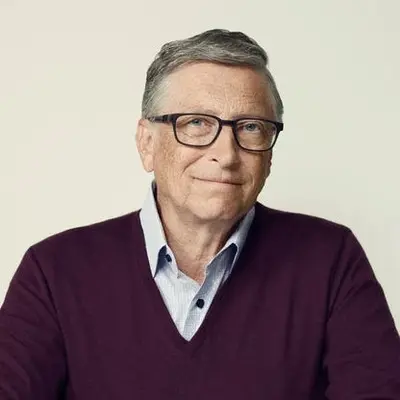
Who Is Bill Gates?
Bill Gates is a prominent American entrepreneur and philanthropist, best known for co-founding Microsoft Corporation, the world’s largest software company. Born in Seattle, Washington, Gates exhibited an early aptitude for technology, writing his first computer program at the age of thirteen.
In February 2025, Gates released Source Code: My Beginnings, the first of a projected three-part autobiographical series. The memoir gives an in-depth picture of Gates’s childhood, high school, and college years.
Most recently, in May 2025, Gates announced he would give away virtually all his wealth — around $200 billion — through the Gates Foundation over the next 20 years. On December 31, 2045, the foundation will close its doors permanently.
Therefore, Bill Gates is not simply a technology icon. He is one of the greatest philanthropists in human history.
Early Life: A Curious Boy in Seattle
Born Into an Ambitious Family
Bill Gates was born on October 28, 1955, in Seattle, Washington, USA, to William H. Gates Sr. and Mary Maxwell Gates. His father was a prominent lawyer, and his mother served on major nonprofit boards. He grew up with two sisters, Kristianne and Libby, in a supportive household that emphasized education, values, and curiosity.
From an early age, Bill was different. He was relentlessly curious, was obsessed with books, and consumed encyclopedias the way other children read comic books.
His father, William Gates Sr., was a prominent lawyer. His mother, Mary Maxwell Gates, was involved in philanthropy. Both parents instilled in young Bill a deep sense of responsibility — to think big, and to use success to serve others.
The Lakeside School: Where Everything Changed
After briefly attending public elementary school, Gates’s parents enrolled him at Lakeside School, a private preparatory school. It was at Lakeside that he was initially introduced to computers. By the age of 13, he had already written a program to play tic-tac-toe that allowed users to play against the computer.
The Lakeside School’s Mother’s Club used proceeds from a rummage sale to purchase a teletype terminal for students to use. Gates became entranced with what a computer could do and spent much of his free time working on the terminal.
The Friendship That Would Change Tech History
It was at Lakeside that Gates found his partner and future co-founder.
There, he met Paul Allen, who was two years his senior. The pair became fast friends, bonding over their common enthusiasm for computers and spending much of their free time together working on programs.
Gates said of his late friend: “Our school, Lakeside, held a rummage sale and used the proceeds to buy a teletype terminal. We were obsessed with it. It was really expensive to use — $40 an hour. The only way for us to get computer time was by exploiting a bug in the system.” They “eventually got busted,” he added, “but that led to our first official partnership between Paul and me: We worked out a deal with the company to use computers for free if we would identify problems.”
Harvard University: A Brief Stop on the Way to Greatness
Graduating with one of the highest SAT scores ever recorded — 1590 out of 1600 — Gates entered Harvard University, where he created the programming language BASIC for the MITS Altair, the world’s first personal computer.
In 1973, Gates graduated from Lakeside and enrolled at Harvard University. Originally thinking of a career in law, the Harvard student spent more of his time in the computer lab than in class.
In his freshman year, he lived down the hall from Steve Ballmer, who would later become CEO of Microsoft.
However, Gates’s heart was never fully in Cambridge. His mind was already elsewhere — dreaming of a world where every home had a personal computer.
Founding Microsoft: The Bet That Built an Empire
The MITS Altair Opportunity
In reality, they didn’t have an Altair to work with or the code to run it. But they wanted to know if MITS was interested in someone developing such software. MITS President Ed Roberts was interested and asked the young men for a demonstration. Gates and Allen scrambled, spending the next two months writing the BASIC software at Harvard’s computer lab. Allen traveled to Albuquerque for a test run at MITS, never having tried it out on an Altair computer. To his delight, it worked perfectly, and MITS hired him for the job. Soon after, Gates left Harvard without graduating to work with him.
April 4, 1975: Microsoft Is Born
Paul Allen and Bill Gates founded Microsoft in 1975. It began as a small software company with a simple but audacious mission. Gates believed that a computer would soon be a valuable tool in every home. Most people thought he was wrong. He proved them right.
The IBM Deal That Changed Everything (1980)
In 1980, Gates developed MS-DOS — Microsoft Disk Operating System — for IBM. Two million copies were sold by 1984. By the early 1990s, more than 100 million copies were sold.
This deal was the turning point. Because Microsoft retained the rights to license MS-DOS to other manufacturers, Gates had unlocked a model that would make him the richest person on the planet.
Windows and the Personal Computing Revolution (1985)
In 1985, Gates introduced the Microsoft Windows operating system to compete with Apple.
Windows did not just compete. It dominated. It transformed the personal computer from a hobbyist’s toy into an essential business and household tool. Furthermore, it cemented Microsoft’s position as the defining force in consumer technology for the next two decades.
From Startup to Global Titan
Under Gates’s leadership, Microsoft revolutionized personal computing with products like MS-DOS and the Windows operating system, making him one of the youngest billionaires in history.
Microsoft is now worth more than $3 trillion. It leads in cloud computing, artificial intelligence, and productivity software. Moreover, it is a testament to the vision of a teenage boy who once exploited a computer bug to get free computing time.
Career Milestones at Microsoft
Chairman and CEO: Shaping the Digital Age
From 1981 to 2014, Gates served as Chairman of the Board of Directors for Microsoft. During this time, he guided the company through the explosive growth of the personal computer era, the internet revolution, and the mobile age.
Stepping Back: From Tech to Humanity
On June 27, 2008, Gates retired from day-to-day work at Microsoft to concentrate on philanthropy.
In March 2020, Gates announced that he would be leaving his position on the board of Microsoft to focus on his philanthropic endeavors, including climate change, global health, and education.
He has since transitioned out of daily operations but stayed involved as a technology adviser through 2025. His legacy at Microsoft remains unmatched. However, his greatest work was still ahead of him.
Philanthropy: Saving Millions of Lives
The Gates Foundation (2000)
Beyond his business achievements, Gates is recognized for his philanthropic efforts through the Bill & Melinda Gates Foundation, which addresses global health, education, and poverty.
Today, the nonprofit invests in low-income communities around the world, supports global economic development, promotes gender equality, and continues to champion disease prevention and education.
As of 2024, the Gates Foundation has issued $83.3 billion in grant payments to charitable causes.
Warren Buffett’s Historic Gift
In 2006, billionaire investor Warren Buffett announced a major gift to the Bill & Melinda Gates Foundation. He pledged 10 million shares of Berkshire Hathaway stock, then worth $31 billion.
As of 2025, about 41% of the foundation’s funds have come from Buffett, with the remainder drawn from Gates’s Microsoft fortune. Together, these donations helped the foundation emerge as a uniquely powerful force in global health and education — what Gates has called his “second and final career.”
The Giving Pledge (2010)
In 2010, Gates and Buffett launched the Giving Pledge, a public campaign encouraging billionaires to commit the majority of their wealth to charitable causes. Gates and Melinda French Gates were among the first to sign.
This was not just a personal commitment. It was a cultural movement. It challenged the world’s wealthiest people to rethink the meaning and purpose of their fortunes.
Vaccines, Global Health, and 82 Million Lives Saved
On January 29, 2010, the Gates Foundation announced it would donate $10 billion for vaccine research over the next 10 years.
The foundation has supported the creation of the Global Alliance for Vaccines and Immunization (GAVI) and the Global Fund to Fight AIDS, Tuberculosis, and Malaria, which have collectively saved 82 million lives worldwide.
These are not statistics. These are 82 million human beings who are alive today because of decisions made in Seattle.
The $50 Million Fight Against Alzheimer’s
In November 2017, Gates shared his plan to invest $50 million into the Dementia Discovery Fund and another $50 million toward start-up ventures working in Alzheimer’s research. It was said to be a personal matter for Gates, who has seen the devastating effects of the disease on his own family members, including his father, who died in 2020.
The Biggest Announcement of His Life (May 2025)
In May 2025, Gates announced he would give away virtually all his wealth — around $200 billion — through the Gates Foundation over the next 20 years. On December 31, 2045, the foundation will close its doors permanently.
With a planned $9 billion annual budget over the next 20 years, Gates said the foundation plans to concentrate on a smaller set of high-impact goals — such as eradicating polio, reducing childhood malnutrition, and controlling diseases like malaria — before winding down.
In his own words from his personal blog, “I will give away virtually all my wealth through the Gates Foundation over the next 20 years to the cause of saving and improving lives around the world.”
“It feels right that I celebrate the milestone by committing to give away the resources I earned through the company,” he wrote.
Beyond Philanthropy: Clean Energy and Nuclear Innovation
Breakthrough Energy
On November 30, 2015, Gates assisted in the launch of the Breakthrough Energy Coalition fund during the 2015 United Nations Climate Change Conference. The private fund has more than 28 investors, including Facebook CEO Mark Zuckerberg and Amazon CEO Jeff Bezos.
Gates is also involved in Breakthrough Energy, which promotes clean energy. This venture reflects his conviction that solving climate change is one of the defining challenges of the 21st century.
TerraPower: A Nuclear Future
In 2024, TerraPower — the company Gates had founded in 2008 and for which he served as chair — broke ground for a new nuclear power plant, aiming to use an advanced nuclear reactor.
Gates said: “I also started a company called TerraPower to bring safe, clean, next-generation nuclear technology to life. Both of these ventures will earn profits if successful, and I will reinvest any money I make through them back in the foundation.”
Source Code: My Beginnings — A Memoir for the Ages (2025)
In February 2025, Gates released Source Code: My Beginnings, the first of a projected three-part autobiographical series. The memoir gives an in-depth picture of Gates’s childhood, high school, and college years.
The book traces Gates’s journey from childhood to the founding of Microsoft in 1975. Gates revealed through a blog post that his memoir discusses the tougher parts of his early life, including feeling like a misfit as a kid, clashing with his parents as a rebellious teenager, dealing with the sudden loss of someone close to him, and almost being expelled from college.
In an interview with CBS News, Gates discussed the book, referencing his somewhat privileged childhood, his challenges with social interaction, and how he viewed the world through a “prism of mathematics” growing up. The book ends in 1979 — just before Microsoft would take off and become a global phenomenon.
Personal Life
Marriage, Divorce, and Family
In August 2021, Bill Gates and Melinda French Gates finalized their divorce after previously announcing their intention to separate in May of that year.
In June 2024, Melinda left her role as longtime leader of the foundation in the wake of her divorce from Bill. The organization has since been renamed the Gates Foundation, with Bill continuing to serve as co-chair and as a member of its board.
Bill and Melinda have three children together: Jennifer Katharine Gates, Rory John Gates, and Phoebe Adele Gates. Despite the divorce, Gates has remained deeply committed to the causes they built together.
Net Worth and Legacy
Bill Gates’ net worth in 2026 is estimated at $104 billion, according to global billionaire rankings. However, he said his net worth will fall 99% by 2045 — a voluntary reduction that reflects not just generosity, but a profound philosophy about the purpose of wealth.
Historians seem likely to view Gates as a business figure as important to computers as John D. Rockefeller was to oil.
Career and Life Timeline
| Year | Milestone |
|---|---|
| 1955 | Born in Seattle, Washington |
| 1967 | Enrolled at Lakeside School; met Paul Allen |
| 1972 | Co-founded Traf-O-Data |
| 1973 | Enrolled at Harvard University (SAT: 1590/1600) |
| 1975 | Dropped out of Harvard; co-founded Microsoft with Paul Allen |
| 1980 | Developed MS-DOS for IBM |
| 1985 | Launched Microsoft Windows |
| 2000 | Co-founded Bill & Melinda Gates Foundation |
| 2008 | Retired from day-to-day Microsoft operations |
| 2008 | Founded TerraPower |
| 2010 | Launched Giving Pledge with Warren Buffett |
| 2014 | Stepped down as Microsoft Chairman |
| 2020 | Left Microsoft board of directors entirely |
| 2021 | Divorced Melinda French Gates |
| 2024 | TerraPower broke ground on a nuclear power plant |
| 2025 | Released memoir Source Code: My Beginnings |
| 2025 | Pledged 99% of wealth ($200 billion) by 2045 |
| 2045 | Gates Foundation to permanently close |